

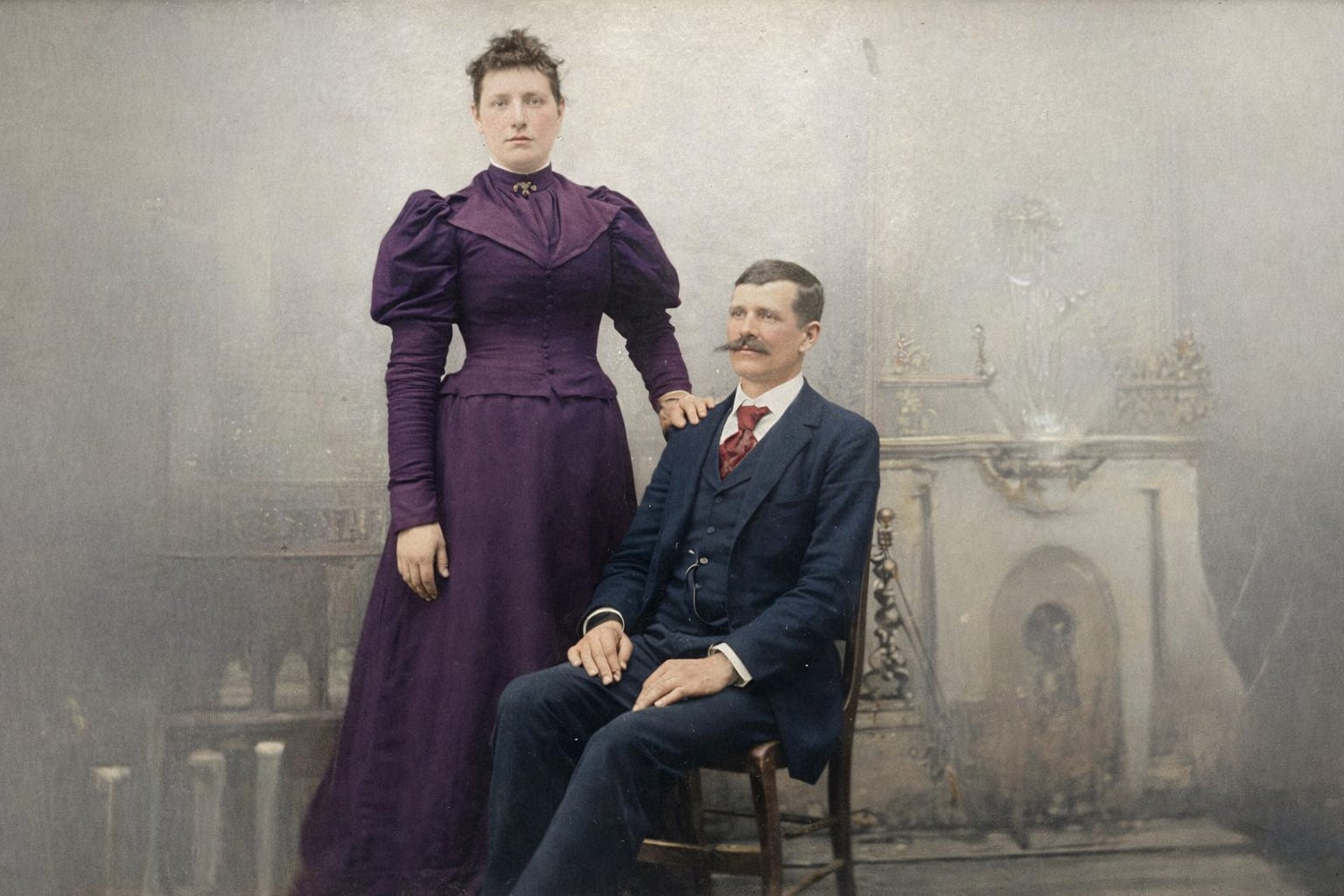
Frank Hughett: Scott County's ninth sheriff
On third assassination attempt, Frank Hughett died in an ambush

You’re reading “Echoes in Time,” a weekly newsletter by the Independent Herald that focuses on stories of years gone by in order to paint a portrait of Scott County and its people. “Echoes in Time” is one of six weekly newsletters published by the IH. You can adjust your subscription settings to include as many or as few of these newsletters as you want. If you aren’t a subscriber, please consider doing so. It’s free!
Today’s newsletter is sponsored by the Scott County Chamber of Commerce. Since 1954, the Scott County Chamber of Commerce has advocated for a strong community by supporting stronger infrastructure and leadership.

Frank Hughett: Scott County’s ninth sheriff
We often think of our present day as being more lawless and dangerous than times past, reminiscing about the days when we could leave our doors unlocked without worrying about intruders entering our home to cart off everything we own, or predators targeting our children. But the past isn’t always as rosy as we remember it, and the late 19th and early 20th centuries were actually quite violent compared to the relatively peaceful times we live in now.
In this modern day, few people would dare try to gun down the high sheriff in public. But there was a time when attempts on the life of whoever held that office in Scott County were not just commonplace but even expected. None of those incidents was more brazen or shocking than the 1926 assassination of Sheriff Richard D. Ellis in the front door of the county jail in Huntsville.
But Richard Ellis wasn’t the only sheriff in Scott County’s history who had crosshairs on his chest. Another one who did was one who preceded him in office, Frank Hughett. Several attempts were made to kill Hughett after he killed a man during an arrest attempt, before he was finally gunned down in September 1910, at the age of 59.
Life and Times
John Frank Hughett was born in March 1851, the son of John Hughett (1824-1908) and Christena Lewallen (1829-1875) of Robbins. The Hughett family was very prominent in the Brimstone and Robbins areas in those times, and Frank Hughett’s father, John Hughett, was a long-time justice of the peace from the area. He was commonly called “Squire Hughett,” as justices of the peace (forerunners of today’s county commissioners) were known as squires.
Frank Hughett was one of 10 children. His siblings included Lucinda Hughett Sexton, Jasper Hughett, Rachel Hughett Newport, Amanda Hughett Newport, Mary Hughett Walker, Bettie Hughett Robbins, Dr. Horace Maynard Robbins, Joe L. Robbins, and Etta Robbins.
Jasper Hughett was the first postmaster at the Hughett post office, which was located about where Huntsville Branch empties into Brimstone Creek. He later moved to Robbins and helped establish the town’s bank and Robbins High School, and was also a prominent merchant there.
Frank and Jasper’s mother, Christena, died in 1875, when she was in her 40s. She was buried at the Hughett Cemetery on Brimstone, and John Hughett later lived with her sister, Lucinda Lewallen Robbins. Lucinda’s first husband, Capt. William Robbins, was one of the men who helped establish the Scott County Home Guard during the Civil War. Confederate soldiers attacked his home — which was located in the Slick Rock area on Brimstone Creek — in what became known as the Battle of Brimstone. He died later in the war of typhoid fever at Lexington, Ky.
Although most sources state that John and Lucinda were married, Edward East Barthell wrote in Mountain Stories, published in 1933, that they did not marry: “After Squire’s first wife died him and Lucinda got married, that is not exactly married because they couldn’t get married because Lucinda’s first husband was a captain in the Army and she was getting a pension of $25 a month which she would lose if she ever married again, so they just couldn’t get married, but they lived together the rest of her life…”
Frank and Jasper both married daughters of William and Lucinda: Frank married Amanda on March 23, 1871, and Jasper married Vicie.
Frank and Amanda had six children: William, Vicie, Andrew, John Wesley, Reuben, and Etta. Mandy died around 1891, and Frank Hughett remarried to Abigail Cecil. Her first husband, Millard F. Rosser, died in 1893. Frank later married a third time to Rhoda Shoopman. They had a child together in 1908.
Sheriff of Scott County
Frank Hughett was elected Scott County’s ninth sheriff in 1888, succeeding Beaty Cecil of New River. He was re-elected in 1890 and 1892 before leaving office due to term limits. In those days, sheriffs were limited to three terms of two years each, and it was not uncommon for sheriffs to serve all three terms.
Hughett was succeeded by John Goad, who also had ties to the Robbins area. His parents, Joshua and Elizabeth Robbins Goad, lived in the Hughett community on Brimstone Creek. Elizabeth Robbins, Sheriff Goad’s mother, was a sister to Capt. William Robbins.
During Sheriff Goad’s tenure, he was charged with hanging a man. Mike King, a Winfield resident, had been convicted of murdering a school teacher who was staying at his home, and the jury sentenced him to hang. As sheriff, it was Goad’s duty to carry out the sentence. He considered resigning, but a repentant King told him he must fulfill his duty. He did, but it bothered him so deeply that he opted not to run for sheriff again. Instead, he ran for county trustee.
So, Hughett ran for sheriff again in 1896, and was elected again. He became the first sheriff in Scott County to serve on two different occasions. He served in that capacity the second time around until 1900, when he was succeeded by Thomas Jeffers.
Death
Frank Hughett died on Sept. 19, 1910, at the age of 59. He was working as a foreman on the Cincinnati Southern Railroad at the time. His death certificate lists the cause of death as “gun shot.” He was buried at Robbins Cemetery.
A newspaper called it “cold-blooded murder in a railroad camp.” According to The Journal & Tribune, Hughett was shot from ambush at Cook’s Camp on Smokey Creek, while working on the Tennessee Railroad. The newspaper reported that the shooting occurred at around 8 a.m. on a Sunday morning, with Hughett’s wife and two-year-old baby present. Hughett was sweeping the steps in front of the commissary when he was shot. He died 10 minutes later. Another person in the camp saw a man run from a cluster of bushes on the mountainside after the shooting. Hughett was shot twice under his right arm.
Bloodhounds were brought to the scene from Somerset, Ky. and followed a track that led to the arrest of Joe Low, Nelson Low, Shack Low, John Bunch, and Jeff Bunch, the newspaper reported. The possible motive for the shooting: Joe Low’s brother, Riley Low, had been killed several months earlier by a posse that included Frank Hughett. In fact, Hughett was identified as the man who killed Low, who was wanted on a charge of larceny for allegedly stealing a moonshine still.
The September shooting at Smokey Creek wasn’t the first time an attempt was made on Frank Hughett’s life in 1910. Three months earlier, in June 1910, he was shot and wounded in Oneida. When he fell, the would-be assassin fled the scene, believing he was dead. However, Hughett regained consciousness shortly thereafter and gave chase, though no one was ever arrested.
Just days after he was shot and wounded, Hughett was poisoned with whiskey. The Knoxville News Sentinel reported at the time that Hughett “suffered much” in the second assassination attempt, but that he “is a man of great bravery and refuses to move away.”
Twenty years later, in June 1930, Sheriff Hughett’s son was also murdered. Reuben Lafayette Hughett was gunned down at Copper Ridge in Knoxville at age 43. He was a deputy U.S. Marshall. The suspect was named as Harrison Welch, who shot Hughett as he and other federal officers were serving a warrant that accused Welch of selling liquor. When they arrested Welch, the suspect asked permission to tell his wife he was being arrested. Hughett agreed and followed him into the house, where he was shot.
Reuben Hughett was also buried at Robbins Cemetery.
Thank you for reading. Our next newsletters will be Threads of Life on Wednesday and The Weekender Thursday evening. Want to update your subscription to add or subtract these newsletters? Do so here. Need to subscribe? Enter your email address below!
◼️ Monday morning: The Daybreaker (news & the week ahead)
◼️ Tuesday: Echoes in Time (stories of our history)
◼️ Wednesday: Threads of Life (obituaries)
◼️ Thursday evening: The Weekender (news & the weekend)
◼️ Friday: Friday Features (beyond the news)
◼️ Sunday: Varsity (a weekly sports recap)