


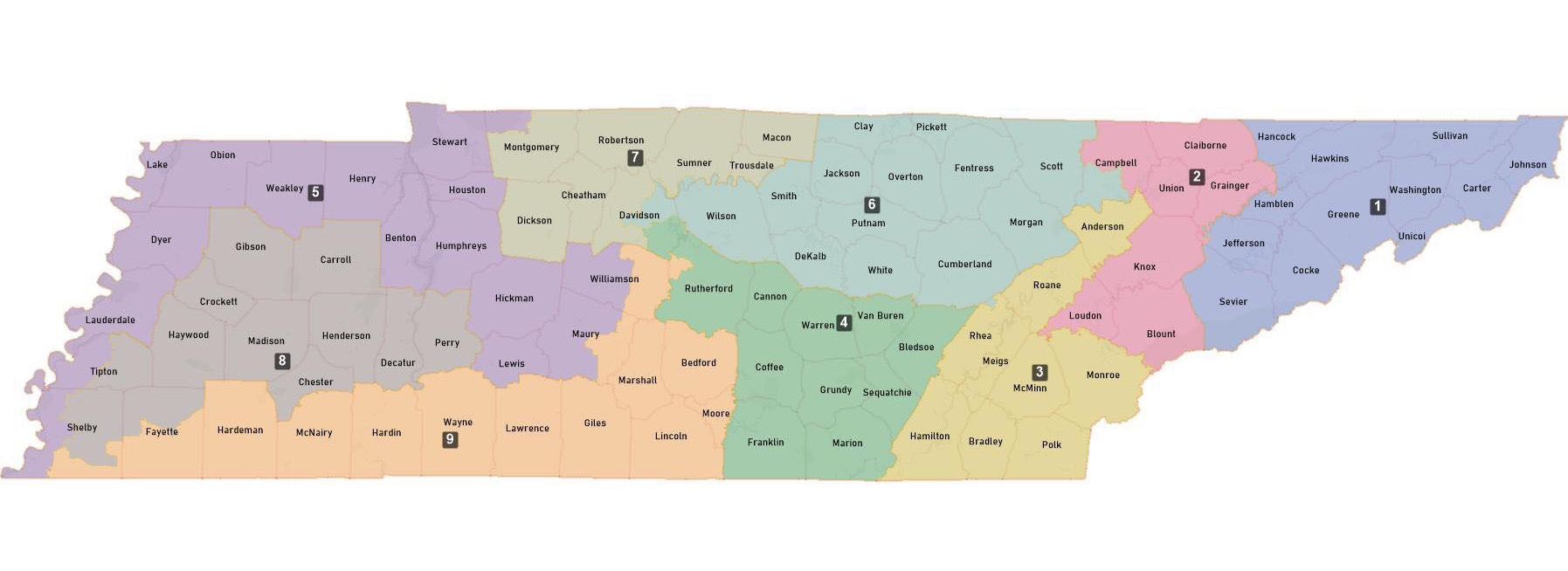
NASHVILLE | If a proposed redistricting map becomes law in Tennessee — and it is expected to — Scott County will be returned to a single congressional district.
Republicans in the Tennessee General Assembly on Tuesday unveiled their proposed redistricting map, which is being considered during a special session in Nashville this week. Gov. Bill Lee called the legislature into special session at the behest of President Donald Trump to consider a new congressional map. The end goal is to eliminate the 9th District, which consists of the city of Memphis and is currently held by Rep. Steve Cohen, a Democrat.
The redistricting is based on a recent Supreme Court ruling that majority-minority congressional districts constitute racial gerrymandering in some instances. While the ruling involved the State of Louisiana, it has opened the door for redistricting efforts in other Republican-led states. The effort is part of a broader response to the Virginia legislature — which is led by Democrats — to redraw congressional districts to eliminate Republican-held seats there, which, in turn, was a response to a similar move by the Republican-led Texas legislature.
Tennessee has nine congressional seats, which is based on the state’s population size. Federal law requires that congressional districts be drawn so that each of the nine districts contains the same number of residents. Traditionally, redistricting occurs after the federal census every 10 years.
As recently as 2008, Democrats held a majority of the congressional seats in Tennessee — five of nine. However, the “red wave” election of 2010 resulted in Republicans ousting the incumbents in three of those districts, leaving Democrat representatives in just two districts: Nashville and Memphis. Following the 2020 census, the legislature redrew the Nashville district, eliminating one of those Democrat-held seats.
As result of that redistricting prior to the 2022 election, Scott County was split into two congressional districts for the first time ever. The southern part of the county, roughly south of S.R. 63, continued to be represented by Chuck Fleischmann, R-Chattanooga, as part of the 3rd Congressional District, while the northern part of the county, roughly north of S.R. 63, was switched to the 6th Congressional District, represented by John Rose, R-Cookeville.
The 6th District also includes part of Nashville, which was divided into several different congressional districts as a result of that redistricting effort.
The new map that has been proposed in Tennessee would divide the city of Memphis into three different congressional districts. The 9th District is currently held by Steve Cohen, a Democrat who has been in office since replacing Harold Ford Jr. in the 2006 election, and who last won re-election in 2024 by better than 20 percentage points. He’s facing a primary challenge this year from state Rep. Justin Pearson.
Not only will the new map make it unlikely that a Democrat will continue to hold Cohen’s seat, based on current demographics, but it also reshapes the 5th District — currently held by embattled Rep. Andy Ogles, R-Culleoka — to ostensibly give him an easier route to re-election. He is the only member of Tennessee’s congressional delegation who had a relatively close race in his last election bid, winning by eight percentage points. The Democratic National Committee has identified the seat as a potential flip opportunity in the 2026 election.
Under the proposed new district boundaries, Campbell County would still be divided into two separate congressional districts. The southern half would shift to District 6 with Scott County, while the northern half would remain in District 2. Morgan County will shift from District 3 to District 6 with Scott County, as well.
Rose is not a candidate for re-election in 2026. He is instead seeking the Republican nomination for governor of Tennessee. Seeking the Republican nomination to replace him are former congressman Van Hilleary — who serves as Rose’s chief of staff — and state Rep. Johnny Garrett.