

The day they formed the Home Guard
In Civil War-era Scott County, a group of men gathered to pledge allegiance to their country and each other

You’re reading “Echoes in Time,” a weekly newsletter by the Independent Herald that focuses on stories of years gone by in order to paint a portrait of Scott County and its people. “Echoes in Time” is one of six weekly newsletters published by the IH. You can adjust your subscription settings to include as many or as few of these newsletters as you want. If you aren’t a subscriber, please consider doing so. It’s free!
Today’s newsletter is sponsored by the Scott County Chamber of Commerce. Since 1954, the Scott County Chamber of Commerce has advocated for a strong community by supporting stronger infrastructure and leadership.

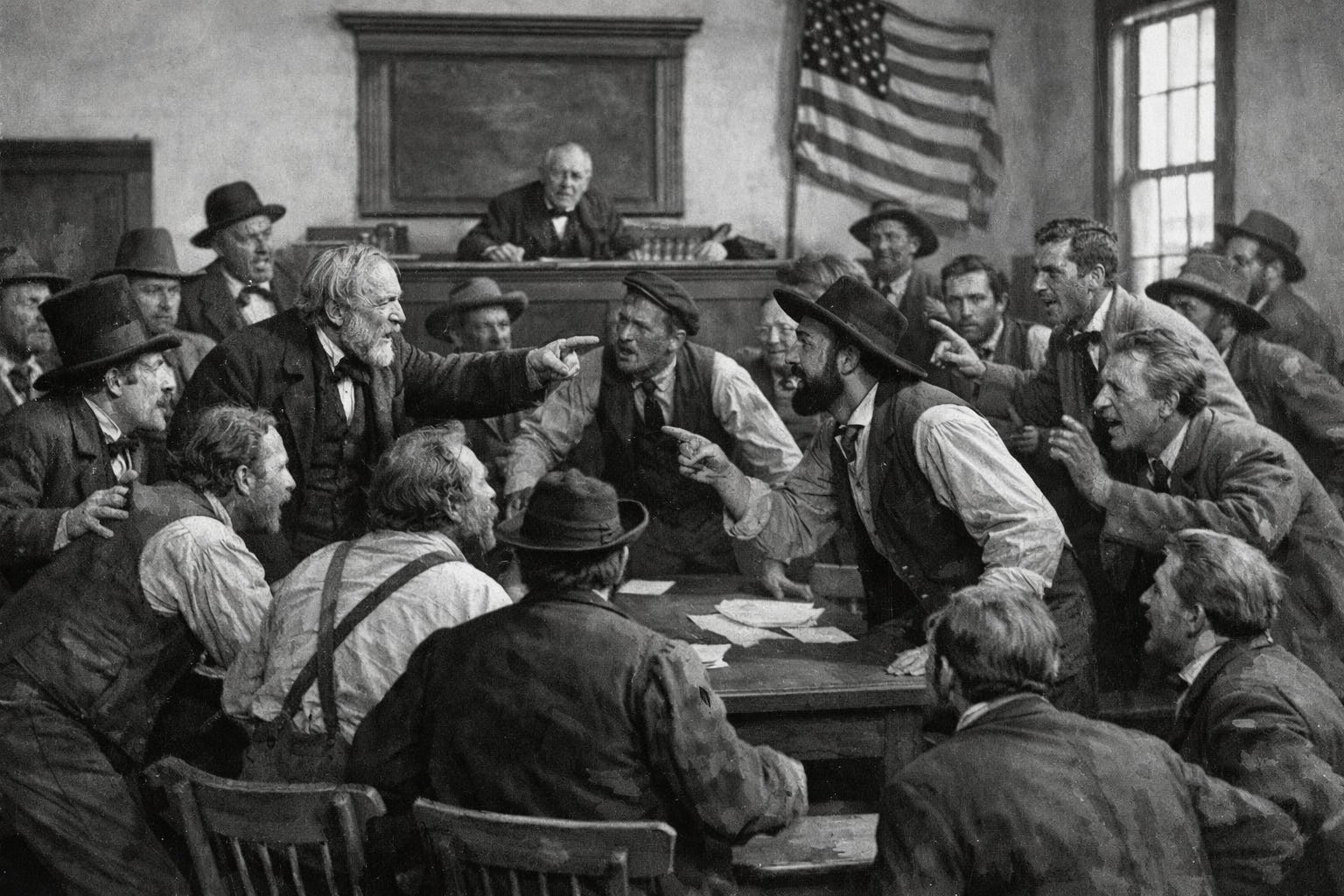
The day they formed the home guard
December 28, 1861. It was three days after Christmas — almost six months since Tennessee voted to secede from the Union, a little more than three since a Confederate regiment had attacked the Smith Creek home of Unionist Hiram Marcum and gravely wounded his 16-year-old daughter, Julia — and Scott Countians were riled up.
America’s Civil War was still young. But, already, guerrilla raids were taking place in Scott County. And it was becoming apparent that this war would not end quickly, as many politicians and military officers had hoped.
So, on Dec. 28, several dozen men from Scott County met at the county courthouse in Huntsville to form a body that would protect the people and farms of this remote part of the Cumberland Plateau. For months — since the war had begun with Confederate forces firing on Fort Sumter in Charleston Harbor — Unionists had been forming what they referred to as “home guards,” which were basically local militias intent on protecting these federally-loyal communities from secessionist troops.
On that day in Huntsville, some 71 men placed their pen to paper and signed an oath forming their own militia — the Scott County Home Guard.
The oath read: “We the undersigned agree and pledge ourselves to each other in a covenant and by our oaths to unite together in a company by the name of a home guard to protect our homes, family, property, and liberties and our neighbors and their property and liberties and also to protect the constitution and the union and not to interfere with any person or persons or their property or liberties that we do not consider interfering with us or ours and for our government we bind ourselves to be controlled and governed by any person who a majority of our company may select for a captain.”
It may have been at this same meeting that Scott County Court voted to declare itself the Free and Independent State of Scott. Newspaper publisher and historian Paul Roy speculated in his 2001 book, Scott County in the Civil War, that this action may have been carried out at the meeting. No one is exactly sure when it happened because courthouse records were lost or stolen during the war — presumably when Confederate troops raided the county courthouse after routing Union forces at the Battle of Huntsville along River Road in 1862.
But this particular document, the oath of the Scott County Home Guard, survived and made its way into the history books.
Among the men who signed it:
George Anderson
Berry Bowling
E. Chaney
John Choate
Pleasant Davis
Thomas Dyer
William A. Edwards
John Gabin
Jonathan Garrett
G.A. Garrett
E.J. Garrett
Hugh H. Garrett
James Goad
W.M. Goad
John Goad
Little B. Goad
Aaron Goad
James Goad Jr.
Joseph Griffith
Andrew Griffith Sr.
Joseph Griffith Sr.
J.M. Hamby
Jury Hamby
Andrew Jackson
John Jeffers
Andrew Lawson
A.R. Lewallen
Michall Lewallen
E. Lewallen
Granville Looper
W.M. Looper
Thomas Looper
Michael Low
James McCartt
Sterling McDonald
Benjamin Solomon Newport
W.M. Newport
Calvin Newport
Ezekiel Newport
James Newport
James Newport Jr.
E.J. Newport Sr.
George Pennington
William Phillips
John Phillips Jr.
Julius Reed
William Robbins
John Sandusky
Hiram Sexton
Fountain Sexton
Julian Sexton
James Sexton
Fielding Sexton
Solomon Sexton
John Stringfield
James J. Stringfield
W.M. Stringfield
James Stringfield
W.M. Todd
Samuel Walker
John M. Webb
Lewis Webb
James Wilson
W.M. Wilson
Elihu Wilson
Solomon Young
Matthew Young
Andrew Young
W.M. Young
W.M. Young Sr.
Several of those men would not survive the war. Joseph Griffith, a member of the 7th Tennessee Infantry, died of illness at a home on Brimstone Creek in March 1863. His brother, Allen Griffith, also died during the war after being taken captive at Wierman’s Mill in Virginia in 1864 and imprisoned at Belle Isle.
Calvin Newport was also a member of the 7th Tennessee, and was killed in a skirmish at Warm Springs, N.C., in October 1863. His father, Richard, died of illness during the war after being imprisoned at Andersonville. An uncle, John Newport, was also killed during the war.
Hiram Sexton died at Belle Isle after being captured at the Battle of Rogersville in February 1864.
James Wilson died of typhoid fever in Williamsburg, Ky., while serving in the 2nd Tennessee Infantry in February 1862.
And then there was Capt. William Robbins.
Raised on Brimstone Creek, about where Gib Griffith Road is located between Slick Rock and Lone Mountain, William Griffith’s home was attacked by Confederate forces on April 1, 1862, in what would become the Battle of Brimstone, which was fought as retribution for him signing the oath of loyalty to the Scott County Home Guard.
William Robbins was 18-years-old and living with Michael Robbins (1781-1870) and Mary “Polly” Lewallen (1802-1880) when the 1850 census was taken. However, they may not have been his parents. In his book, Roy recounted a history of the Robbins family compiled by Mildred Troxel, which stated “William’s mother brought him to Michael Robbins and his wife with the agreement that he could live with the family for two years and if the mother had not returned for him at the end of that period, then they could keep him as their own. When the mother returned to claim her child at the end of the two years, Michael and his wife were too attached to give him up.”
William married Lucinda Lewallen (1835-1913), who was a niece to Mary “Polly” Robbins. They had four children.
Because he was the first person to sign the oath of allegiance to the Home Guard, Robbins’ home was targeted by Confederate troops in the spring of 1862.
That day, a regiment of rebels from Alabama, led by Col. John C. Vaughn, showed up at Brimstone Creek looking for Robbins. Vaughn was himself from East Tennessee, born near Sweetwater and serving as sheriff of Monroe County at the time of Tennessee’s secession. He had raised the Volunteer State’s first regiment of Confederate soldiers, and played a key role at Bull Run, the first major battle of the war.
Fortunately for Robbins, he was not at home that day. He and other members of the Home Guard were encamped on the ridge top — a strategic move that allowed them to be in either Brimstone or Huntsville on the other side of the mountain in just a few minutes’ time if trouble presented itself.
In his book, Dusty Bits of the Forgotten Past, historian H. Clay Smith wrote that the rebel soldiers surrounded the Robbins home, waking up Lucinda.
“The raiders took everything the lady had to eat and began to make fires and prepare breakfast for themselves,” Smith wrote. After eating, they sent scouting parties out to forage and to search for Robbins.
Meanwhile, Robbins and the rest of the Home Guard were formulating a plan of attack. During the predawn hours of April 2, the Home Guard a ttacked, flanking the cabin on both sides while also mounting a frontal attack. A McCreary County man, Ambers Strunk, was killed in the fighting.
Others were killed, too, though no one agrees on how many. Smith wrote that the rebels were confused, firing on each other. By daylight, “they had dead and wounded all over the mountainside,” he wrote.
The Confederates told a much different story. John Offield, one of the rebel soldiers, who penned a letter to his father stating that Scott Countians were more pro-Union than any other community he had traveled through after leaving Virginia, wrote that he and his comrades killed 15 Scott Countians and wounded 20 more — despite the Yanks outnumbering the Rebs 120 to 27. Confederate Lt. Crockett R. Millard, who was wounded in the fight, wrote that the rebels had four men killed and 11 wounded, one mortally, while Scott County had 30 people killed and 18 taken prisoners. Still another account came from the Knoxville Register newspaper, which claimed that four rebels were killed and 10 wounded, while 30 to 40 of the “jayhawkers” were killed and another 18 were taken prisoner — some of whom were killed during an escape attempt. The Knoxville newspaper’s story was likely based on the account of Millard. The Register wrote: “The victory seems to have been a most complete one and as usual the Federals greatly outnumbered our forces. If the reports of this affair are confirmed by the official accounts, the gallant Vaughn has added new laurels to those he achieved at Manases (sic).”
The rebel accounts were almost certainly exaggerated — and probably drastically so. There is no record of anyone from the Home Guard being killed except Ambers Strunk. But Smith’s version was perhaps also exaggerated, especially a claim that the Confederates stacked their dead into abandoned outbuildings and set fire to them.
In truth, though, the Home Guard appears to have won the battle, as Vaughn’s regiment was forced to retreat from the Robbins home.
Meanwhile, Robbins decided to enlist in the regular army. He joined Col. William Clift’s 7th Tennessee Infantry at Huntsville on July 1, 1862, and was appointed captain. Several weeks later, after the 7th Tennessee was routed at the Battle of Huntsville and departed Scott County to serve elsewhere, Robbins wrote out his will, stating that he was leaving with the army and feared he would not return.
Sadly, that proved to be true. He died of typhoid fever at Lexington, Ky., on April 16, 1863. He is buried at Lexington National Cemetery.
Read More: A Marked Man: The Battle of Brimstone