


You’re reading “Echoes in Time,” a weekly newsletter by the Independent Herald that focuses on stories of years gone by in order to paint a portrait of Scott County and its people. “Echoes in Time” is one of six weekly newsletters published by the IH. You can adjust your subscription settings to include as many or as few of these newsletters as you want. If you aren’t a subscriber, please consider doing so. It’s free!
Today’s newsletter is sponsored by the Scott County Chamber of Commerce. Since 1954, the Scott County Chamber of Commerce has advocated for a strong community by supporting stronger infrastructure and leadership.

Esau Laxton was the first of the Laxton lawmen
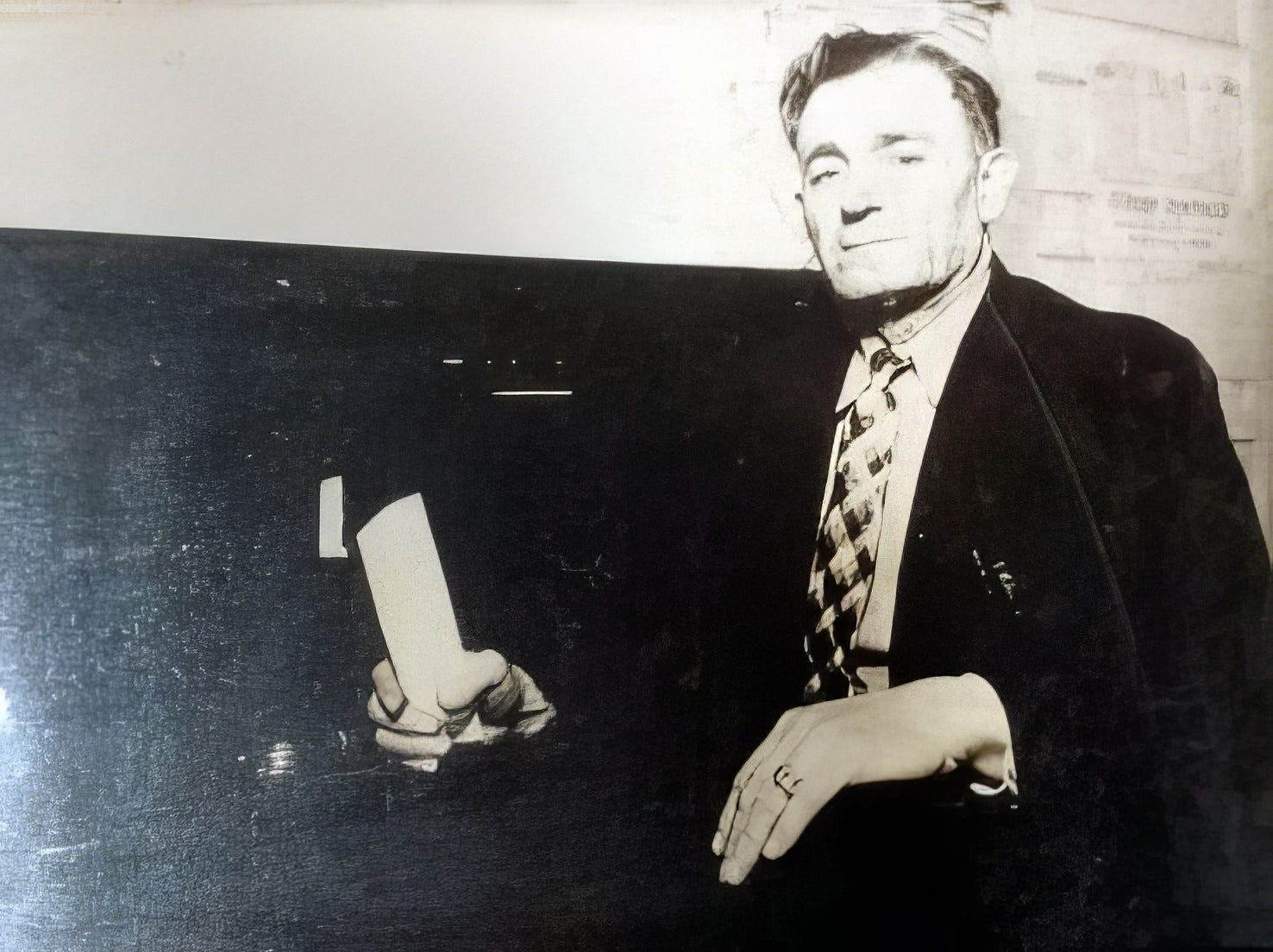
Through the years, there has perhaps been no name more synonymous with law and order in Scott County than Laxton. Darryl Laxton is the current chief of police in Oneida, and Jack O. Laxton served as sheriff of Scott County on different occasions that spanned parts of three decades: the 1960s, the 1980s and the 1990s.
But it all began with Esau Laxton, Jack O. Laxton’s father, when he was appointed sheriff of Scott County in 1929.
Born June 6, 1884, William Esau Laxton was the son of Isham Laxton (1865-1941) and Paralee Trammell (1866-1932) of the Buffalo community in eastern Scott County.
By Esau’s time, the Laxton family had become well entrenched in Scott County. His great-grandfather, Thomas Laxton (1795-1862), was the first Laxton to move to present-day Scott County, settling on Buffalo Creek. He married his wife, Elizabeth Goad, in 1820, after making the move to Tennessee, and they had seven children.
The Laxton family were heavily involved in military service. Thomas Laxton served in Cpt. James Tunnell’s East Tennessee Militia during the War of 1812. He had sons who fought for both the North and the South during the Civil War. Brothers Thomas Laxton Jr., Alfred and Levi all served in the Union army, while Jesse Laxton served in the Confederate army.
Esau Laxton’s paternal grandfather was John Jackson Laxton, who married Amanda “Milly” Sharp, daughter of Isham Sharp and Sarah Joyce. Like so many of his ancestors, Esau served in the military, enlisting in the U.S. Army and obtaining the rank of sergeant.
Laxton married Laura B. West, daughter of William Wesley West and Cynthia Reynolds, and they had four children: Virgil, Wilbert, Lester, and Nesby. Nesby, who married Ira Carr Pemberton, would later serve as mayor of Sunbright.
Following Laura’s death in 1917, Esau remarried to her sister, Mertie Mae West. They had a number of additional children, including Evelyn, Dilbert, Thurman, Jack, Doris, Mary, William and Verlie Jo, born between the years 1918 and 1938.
Sheriff of Scott County
In 1928, Sheriff Isham Chambers fell ill, first with measles, then flu, which progressed to pneumonia. He died on April 4, 1928, at age 44, and was the second consecutive Scott County sheriff to die in office. Sheriff Richard Ellis had been assassinated three years earlier.
Like Laxton, Chambers was from the Buffalo community in eastern Scott County, the second-great-grandson of Revolutionary War veteran William Chambers. In fact, Chambers was married into the Laxton family. He married Nancy Jane Laxton (1887-1969), who was Esau Laxton’s sister.
After Chambers’ death, Esau Laxton was appointed by the Scott County Court — a precursor to what is now Scott County Commission – to fulfill the vacant office of sheriff. He served until the 1930 election, when he was formally placed in office by the voters of Scott County. He was subsequently re-elected in 1932, serving a total of five years before being replaced by Herbert Bilbrey in 1934. He was elected again in 1936, serving two more years as sheriff before being replaced by Frank Butler in 1938.
The Boyatt lynching
Laxton was sheriff when Jerome Boyatt and another man, Harvey Winchester, were lynched in 1933. Both were accused of killings in unrelated incidents.
Jerome Boyatt had shot and killed Pickett County Sheriff George Winningham and his son, deputy Floyd Winningham, during a confrontation at a logging camp on Rock Creek earlier that year. An all-out manhunt had ensued in the No Business community where the Boyatt family lived. Although No Business was located in Scott County, the manhunt was led by George Winningham’s son, Kentucky lawman Willie Winningham, who did not have jurisdiction in Scott County. During that manhunt, Jerome’s father, Ransom Boyatt, was found dead at the family farm and an inquest ruled his death a homicide. No one was ever charged, but the murder of his father was enough to convince Jerome to turn himself in to Scott County authorities.
On June 9, 1933, a mob of 25 masked men arrived at the Scott County Jail in Huntsville, where they beat the jailer and kidnapped Boyatt and Winchester, a 19-year-old from Kentucky who had been charged with killing Esker Thompson and Namon Perry in Winfield. The next day, the two men’s tortured and bullet-ridden bodies were discovered in the woods off Highway 27 in Helenwood. According to reports, Boyatt had been stripped of his clothing and forced to run as the mob fired at him. He was shot twice in the back, and once in the back of the head at close range, execution-style.
Laxton was not in town when Boyatt and Winchester were kidnapped from the jail and murdered. The jailer who was beaten by the mob was his cousin, E.N. Laxton. In a June 12, 1933 article in the Knoxville Journal, Laxton told reporters that he was “making progress” in an investigation into the identity of the vigilante mob, and predicted that action would be taken within a couple of days.
No arrests were ever made, though it has long been suspected that the slain sheriff’s son, Willie Winningham, was responsible.
A lawman’s legacy
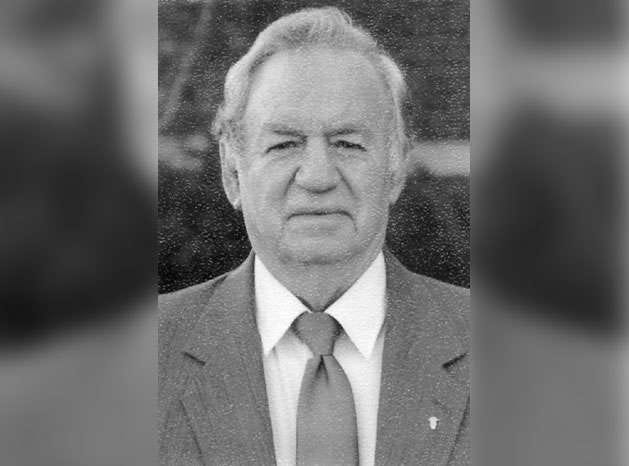
Esau Laxton died on Oct. 15, 1956 at age 72 and was buried at the Laxton family cemetery on Buffalo Road. His service was just the start of the family’s legacy in Scott County law enforcement. His son, World War II veteran Jack Oran Laxton, served as Scott County’s sheriff from 1962 to 1968, leaving office after three two-year terms due to term limits that were in place at the time, and later returning to office in 1986, serving two four-year terms before leaving office for good in 1994. Jack Laxton was credited with being the first sheriff to place markings on patrol cars, and the first to require deputies to wear standardized uniforms.
Another of Esau’s sons, William Esau “Bill” Laxton Jr., served as chief of police in Oneida. And his grandson, Darryl Laxton — Jack Laxton’s son — is the current chief of police in Oneida, a post he has held for the past 15 years.
Several of Esau’s other grandsons also served in Scott County law enforcement — including Jeff Laxton, who served as his father’s chief deputy. The late Mike Cross, who was elected sheriff in 2010, got his start in law enforcement as a deputy under Jack Laxton. He served as chief of police in Oneida from 1995 to 2010.
Thank you for reading. Our next newsletters will be Threads of Life on Wednesday and The Weekender Thursday evening. Want to update your subscription to add or subtract these newsletters? Do so here. Need to subscribe? Enter your email address below!
◼️ Monday morning: The Daybreaker (news & the week ahead)
◼️ Tuesday: Echoes in Time (stories of our history)
◼️ Wednesday: Threads of Life (obituaries)
◼️ Thursday evening: The Weekender (news & the weekend)
◼️ Friday: Friday Features (beyond the news)
◼️ Sunday: Varsity (a weekly sports recap)