

Clay and Blood: The Frank Williams Murder
The 1905 murder of a Brick Yard boss forever changed the racial demographics of Scott County, Tennessee


You’re reading Friday Features, a weekly newsletter containing the Independent Herald’s feature stories — that is, stories that aren’t necessarily straight news but that provide an insightful look at our community and its people. If you’d like to adjust your subscription to include (or exclude) any of our newsletters, do so here. If you haven’t subscribed, please consider doing so!
Today’s newsletter is sponsored by First National Bank. Since 1904, First National Bank has been a part of Scott County. First National is local people — just like you. Visit fnboneida.com or call (423) 569-8586.

Clay and Blood: The Frank Williams Murder

The Brick Yard smelled like the earth being punished.
Maybe that’s how Frank Williams had always thought of it. If it was, he never said so to anyone. You didn’t say things like that to the big wigs at the Southern Clay Manufacturing Company offices in Chattanooga. You said things like “production is up” and “the kiln’s running clean” and “yes sir, the boys are working steady.” You kept the poetry to yourself and you kept the ledgers straight and you tried not to think too hard about the red clay dust that worked its way into your lungs one breath at a time, slow and patient like bad debt.
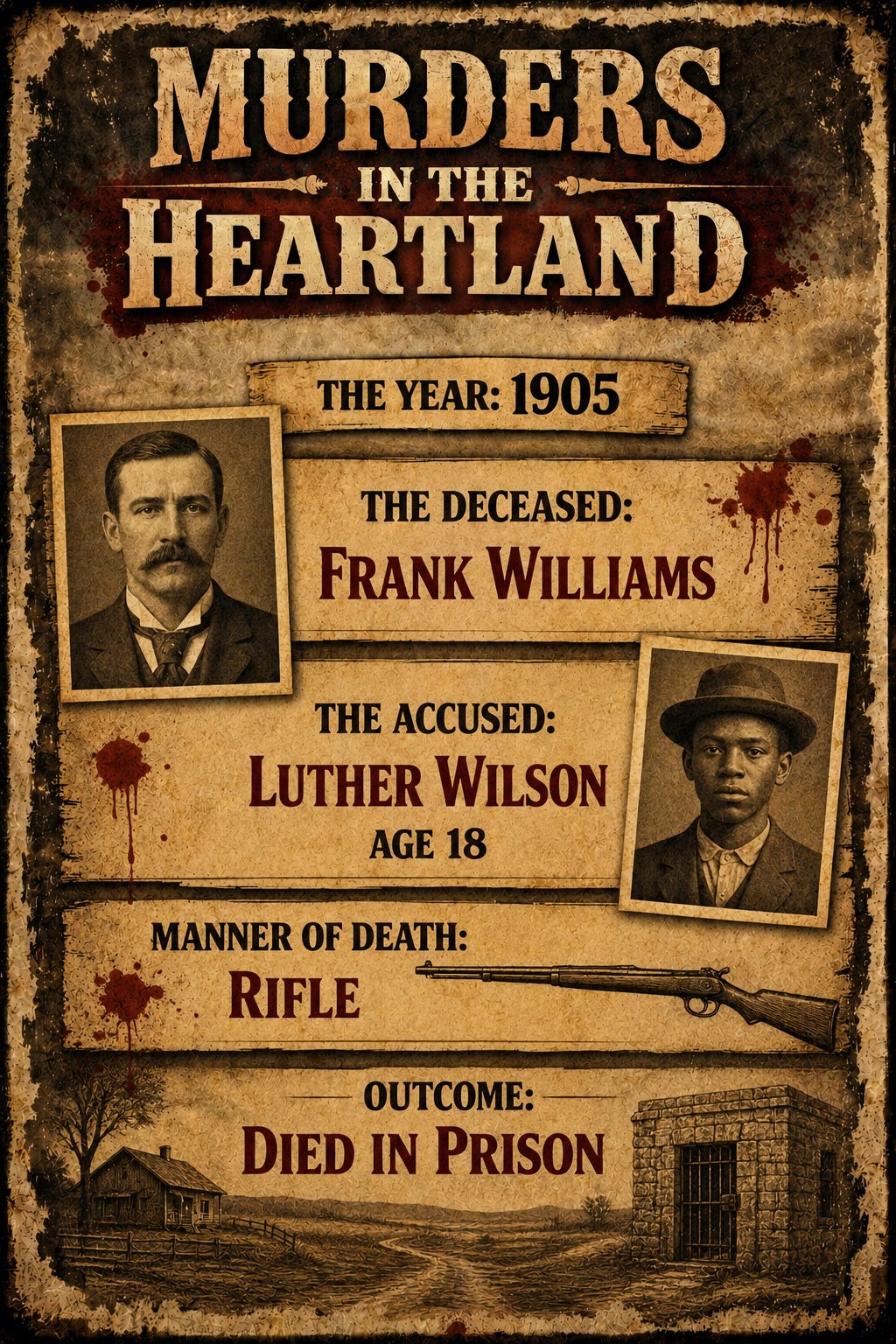
Frank Williams, age 30, timekeeper and shipping clerk, had been working steady himself. Three years in the mountain hollow at Robbins, where the clay came out of the hillside dark red as a wound and the kilns roared day and night and the workers moved through the dust like ghosts that hadn’t finished deciding whether to haunt the place or leave it.
He had been good at his job. He had been fair, or at least he had believed so, which is not always the same thing but which mattered to Frank Williams in the way that certain beliefs matter to certain men — not as beliefs but as identity. As the thing you are when you strip everything else way.
Frank Williams did not know, on the morning of Wednesday, January 11, 1905, that he had less than four hours to live.
***
The trouble had been building the way trouble always builds in places where men work hard for money that never feels like enough: slowly, invisibly, the way water finds the crack in the foundation wall.
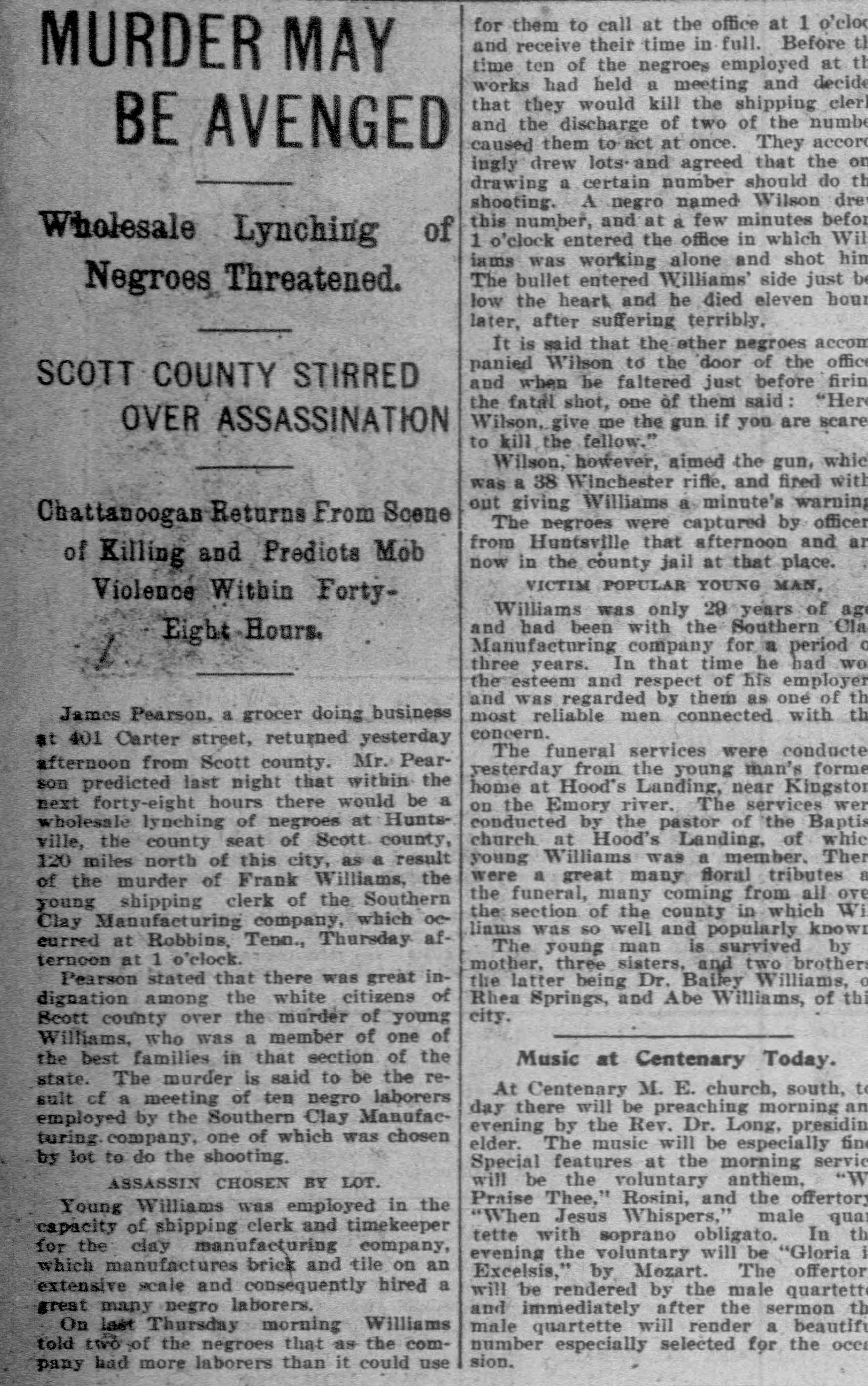
There were too many men. That was the plain fact of it. The company had hired beyond its need, and the work had slowed with the season. Someone had to go. Frank Williams had looked at his ledgers on that January morning — the cold pressing in around the office door, the kilns banging and roaring out beyond the frosted windows — and he had made the calculations that needed making.
Some would later say that the men who were fired that morning hadn’t been doing their fair share of the work. Some even said that Williams had asked them to work harder, and they had refused. One way or another, Williams called a couple of them in and told them to come by at one o’clock to collect their time. He was not cruel about it. He had not been raised to be cruel. But he was not, perhaps, as careful as he might have been about what was happening in the yard beyond his window, in the cold spaces between the kilns where men gathered to talk in low voices and watch the office door with eyes that had been watching white men’s doors for a long time and had learned to read them in ways Frank Williams could not have imagined.
Frank Williams, you see, was white. Many of the laborers at the Brick Yard were black, drifting up to Robbins from Alabama, Georgia, and points further south. And what was about to happen on that January morning would light a fuse of racial animosity that would have implications for generations to come.
***
What happened next, Frank Williams did not see. He was alone in his office with his ledgers and his cold breath making small clouds in the air and perhaps a thought or two about his old hometown — Hood’s Landing in Roane County — and the Emory River and his mother’s face.
Out in the yard, eight men gathered.
What was said between them, what grievances were named, what fear and fury and desperation found its voice in that huddle of men in January — that is a room history did not enter. We have only the outcome. We have the terrible arithmetic of what was decided: that one man would be chosen. That the choosing would be done by lot, which is a very old and very human way of making the unbearable feel like fate rather than choice.
Ten of them drew. One of them drew the mark.
His name was Luther Wilson. He was just barely 18, originally from Campbell County. He had a brother named Arthur who worked at the Brick Yard with him, four more siblings back at home near LaFollette, and none of them knew, in that moment, that the piece of straw or the folded paper or whatever it was that Luther Wilson pulled from someone’s fist was going to determine the shape of the rest of all their lives.
The gun was a Winchester rifle, .38 caliber, a serious instrument for a serious purpose. Someone had brought it or someone fetched it, and passed it into Luther Wilson’s hands. And the mob of angry workers moved toward the office.
***
They said afterward that Luther Wilson faltered at the door.
A moment of hesitation, the Winchester rifle heavy in his hands, the office door close enough to touch, the man inside unaware, and Luther Wilson standing in that terrible corridor between what he had agreed to do and what his body understood was about to happen.
“Here, Wilson,” someone said. “Give me the gun if you are scared to kill the fellow.”
Luther Wilson did not give up the gun. He marched into Frank Williams’ office. He aimed the rifle. He fired.
***
The bullet entered Frank Williams’ right side and passed entirely through his body. He was seated at his desk when it happened. He may have heard the door. He may have looked up. The newspapers do not say.
What the newspapers say is that he lived for 10 more hours.
Ten hours is a long time to lie in your body with a hole through it, knowing you’re going to die. Long enough to make a dying declaration — “I was shot without provocation,” the words of a man trying to set the record straight before he ran out of time to set anything.
The sound of the shot brought James Cook, a deputy sheriff, out of a nearby store at a run. He learned who had fired and took up the chase, and here is where the story acquires one of its stranger graces: Cook ran Luther Wilson down after a quarter mile, and Luther Wilson still had the Winchester. Cook had only a revolver, and Luther Wilson was young and desperate and the gun was in his hands. But Cook walked up to him anyway, got the drop, and took him peacefully.
The other arrests followed within hours.
By nightfall, the hollow at Robbins had become something else entirely. Word had spread the way word spreads in mountain communities, person to person, across ridgelines and down creek beds, and what traveled with it was not merely information but heat, the old terrible heat that collects around certain kinds of crimes in certain kinds of places and becomes a thing with its own momentum and its own appetite.
Lynchings were still common in the early 1900s, and folks in Scott County didn’t take too kindly to accused murderers. They had hanged two men accused of murdering Talitha Harness and her mentally disabled son in 1889. More would follow. Through the years, there were more lynchings in Scott County than in any other county in East Tennessee.
A couple of white men killing a white woman was bad enough. But black men killing a well-liked white man? The writing was on the wall, plainly visible for anyone who cared to look. A newspaper in Chattanooga reported that a lynching was imminent: the three accused men, including Luther Wilson and his brother, Arthur, would soon be hanged by a mob.
***
William J. West was a newly elected sheriff in Scott County, a young man, and he was the only thing standing between three handcuffed prisoners and several hundred people who wanted to kill them. He had no horse, no train, no telephone line that would bring him help before the mob arrived.
Somehow, West got the men from Robbins to the county seat in Huntsville. According to The News & Advance, he hid them in a farmhouse rather than placing them in the county jail because he knew a mob was looking to hang them. At a preliminary hearing before the week was out, a judge bound the men over, ordering them to stand trial on murder charges. For one reason or another, the mob’s fury began to grow again. Down in Rockwood, Frank Williams’ family and friends began to board trains to make the trip to Robbins.
Sheriff West was in Robbins, nine miles away from Huntsville, when he learned that mobs were assembling at three different points. He walked the nine miles to the county jail, roped his three prisoners to one another, and set out for Knoxville — intent on keeping them safe.
All West had was his legs, his nerve, and an understanding of the people he was dealing with — which is to say, his neighbors, his constituents, men he likely knew by name — and a deputy named Joe Hughett who was willing to walk through the mountains at nine o’clock on a January night.
But West had something else — an intelligence that belied his youth. Before leaving Huntsville, he spread rumors. He told different people different things about where he was going, knowing that rumors, like water, find every crack, and that a mob following contradictory trails splits and loses itself. Then he took the three men — Luther and Arthur Wilson and Jule Henderson, handcuffed and roped together — and he walked them into the dark, as the mob closed in on Huntsville.
The mountains in January. No road, no path, the rough country of Scott County in the small hours, the ground frozen and uneven, three men tied together stumbling over terrain that would have been hard going even in daylight even alone. The night was clear and cold and the mob was somewhere behind them in it, torchlight moving through the hollows, voices carrying on the mountain air.
And the whole way, the three men prayed.
Luther Wilson was just 18, still a teenager. Arthur wasn’t much older. Neither was Henderson. They prayed and they moaned and they wept and they begged Sheriff West to save them, the words tumbling out into the frozen dark, and West kept them moving, kept himself between them and whatever sound rose up from the valley below. “The night was made hideous to (Sheriff West) through the praying and the begging of the negroes that he save them,” a newspaper wrote.
Nineteen miles. All night. They reached Pioneer at dawn.
They took the train to Knoxville. The prisoners, West reported, did not understand they were safe until they were on board and the platform was moving away behind them. Against all odds, the sheriff had gotten his prisoners out of the mountains alive.
***
The trial was held at the next term of the circuit court in Huntsville. E.G. Foster defended the men. D. Cecil, H. Clay James, and J.F. Baker prosecuted. The jury returned a verdict of second-degree murder.
Second degree.
Not first. The drawn lots, the plan hatched in the cold yard, the men assembled at the door — the law looked at all of it and arrived at second degree, which is a verdict that contains its own argument about intention and premeditation, an argument that lawyers make and juries accept and history neither confirms nor refutes.
The sentence was 15 years for each man.
***
Luther Wilson did not serve 15 years.
He entered the state prison in Nashville and on June 11, 1909 — four years and some months after that January morning in Scott County — he died of pneumonia. He was 22 years old. His body was returned to LaFollette for burial.
Arthur Wilson — Luther’s brother — was sent to Brushy Mountain. After he got out, he moved to West Virginia. He had mined coal at Brushy as a convict doing hard labor. He mined for pay in West Virginia. He married a woman named Fannie Floyd in 1922, and they lived the rest of their lives in the West Virginia mountains, where Arthur worked in the coal mines for decades. Luther and Arthur were from Campbell County, Tenn. Another of their brothers, Emmitt, was said by the press to be one of the men who conspired to murder Williams, but he was not charged.
Jule Henderson may have gone to Brushy Mountain, too. If so, he was born in Georgia in 1878. The records are less clear with him.
***
And Scott County. The story didn’t end when Frank Williams was buried, or when the Wilson boys were sentenced to hard labor.
Williams’ death changed Scott County forever.
Esther Sharp Sanderson wrote bluntly about it in her book, County Scott and Its Mountain Folk. When Williams was killed, she later wrote, black people living in Scott County were given two weeks to settle their affairs and get out. Or else. Later, there were big signs posted along the highway at the state line and at the Morgan County line: “N***er, don’t let the sun set on your head.”
Scott Countians were mad. They would not soon forget.
The Chattanooga Daily Times newspaper on Jan. 15, 1905, quoted James Pearson, a grocer who had returned to the city after spending an afternoon in Scott County. Pearson talked about how angry the folks were in Scott County. He predicted that there would be wholesale lynchings of black residents of the community within 48 hours.
The Journal & Tribune newspaper in Knoxville reported that a “wholesale lynching of negroes” was scheduled for Huntsville on a Monday night. Rumors had spread that the men were members of something called the “Break o’Day” society.
Black people — who were very common in Scott County prior to Williams’ death, working on the railroad, or in the coke ovens at Glenmary, or at the Brick Yard — were driven out.
In 1912, three 17-year-old black boys were reportedly killed while walking the railroad tracks in Robbins, after being told “a negro is not even permitted to walk through the village even on the railroad track.” A few years after that, a black man who worked at the Pearson Hardwood Flooring company in Oneida was forced to pack up his family and leave town after a band of 12 masked men went to his home and threatened to dynamite it.
The 1900 census showed that there were 337 black people living in Scott County, making up about 3% of the population. By 1910, there were 77. By 1920, there were only seven. And they never came back.
The newspapers recorded the murder and the trial and the sheriff’s long walk through the mountains with great energy and considerable detail. They recorded the mob that wanted to tear the accused men apart before any court could speak.
They did not record what it meant that between 1905 and 1920, nearly every black person in Scott County vanished from the census rolls. They did not record where those 330 people went, what they carried, what they left behind.
But Brick Yard Hollow at Robbins knew. The earth knew, being patient the way earth is patient, the way it was patient with Frank Williams and Luther Wilson both — receiving them both at the end, indifferent to verdicts, indifferent to justice, asking only that you come when it’s time and lie still and let the cold ground have you.
It always does.
Frank Williams is buried at Hood’s Landing, near Kingston, on the Emory River, in the churchyard of the Baptist congregation to which he belonged. He was thirty years old. He had won, his employers said, the esteem and respect of all who knew him. He had been, they said, one of the most reliable men connected with the concern. He left behind a mother. Three sisters. Two brothers. The floral tributes, the newspaper noted, came from all over the county.
Editor’s Note: This is the latest installment of Murders in the Heartland, the IH’s reimagined series covering particularly noteworthy murders that have been committed in Scott County through the years. In many instances, descendants of both the victims and the perpetrators still live in our community. The intent is not to reopen old wounds or to cast judgment, but to document past events that have an indelible impact on our community’s history. At the conclusion of the series, our book by the same name will be republished in a second, revised edition.
Thank you for reading. Our next newsletter will be The Daybreaker bright and early Monday morning. If you’d like to update your subscription to add or subtract any of our newsletters, do so here. If you haven’t yet subscribed, it’s as simple as adding your email address!
◼️ About the IH • IH Sports Network • The Encyclopedia of Scott County
◼️ Subscribe • Sponsor • Manage Your Account
◼️ Follow us on Facebook, Instagram, X/Twitter, YouTube
Our Newsletters:
• Monday morning: The Daybreaker (news & the week ahead)
• Tuesday: Echoes from the Past (stories of our history)
• Wednesday: Threads of Life (obituaries)
• Thursday evening: The Weekender (news & the weekend)
• Friday: Friday Features (beyond the news)
• Sunday: Varsity (a weekly sports recap)