

He walked the wrong road alone
Willis Greene's only crime in 1923 was walking Big Ridge Road alone as a black man


You’re reading Friday Features, a weekly newsletter containing the Independent Herald’s feature stories — that is, stories that aren’t necessarily straight news but that provide an insightful look at our community and its people. If you’d like to adjust your subscription to include (or exclude) any of our newsletters, do so here. If you haven’t subscribed, please consider doing so!
Today’s newsletter is sponsored by First National Bank. Since 1904, First National Bank has been a part of Scott County. First National is local people — just like you. Visit fnboneida.com or call (423) 569-8586.

He walked the wrong road alone
They buried him where he dropped: on the side of a lonely road that snakes through the hills west of Oneida. No obituary. No trial for his name. Just a crude marker in the dirt, poured from a bucket of concrete, etched with three words: Negro Willis Greene.
That was 90 years ago. The stone’s still there.
So is the story.
And like most stories that linger in the dark corners of the past, this one begins with a man in the wrong place at the wrong time. Not because he was guilty. But because, in the summer of 1923, being a black man walking alone through Scott County was all it took.
***
It wasn’t always that way. There was a time, not long before the killing, when Scott County had been home to hundreds of black men, women and children. Especially in the southern end of the county, where labor was cheap and hands were needed, the black population made up a sizable portion of the workforce. Timber. Railroad. Mines.
But then the violence came.
A white man was killed. And that was enough.
Local history books — like County Scott and Its Mountain Folk by Esther Sharp Sanderson — remember it plain: the black community was given a deadline. Two weeks. Liquidate what you owned, get out, or else.
At the Kentucky line and again at the Morgan County line, hand-painted signs spelled it out: “N***er, don’t let the sun set on your head.”
Most didn’t. They left. Fast.
But in July 1923, one man either hadn’t heard the warning, or didn’t care.
***
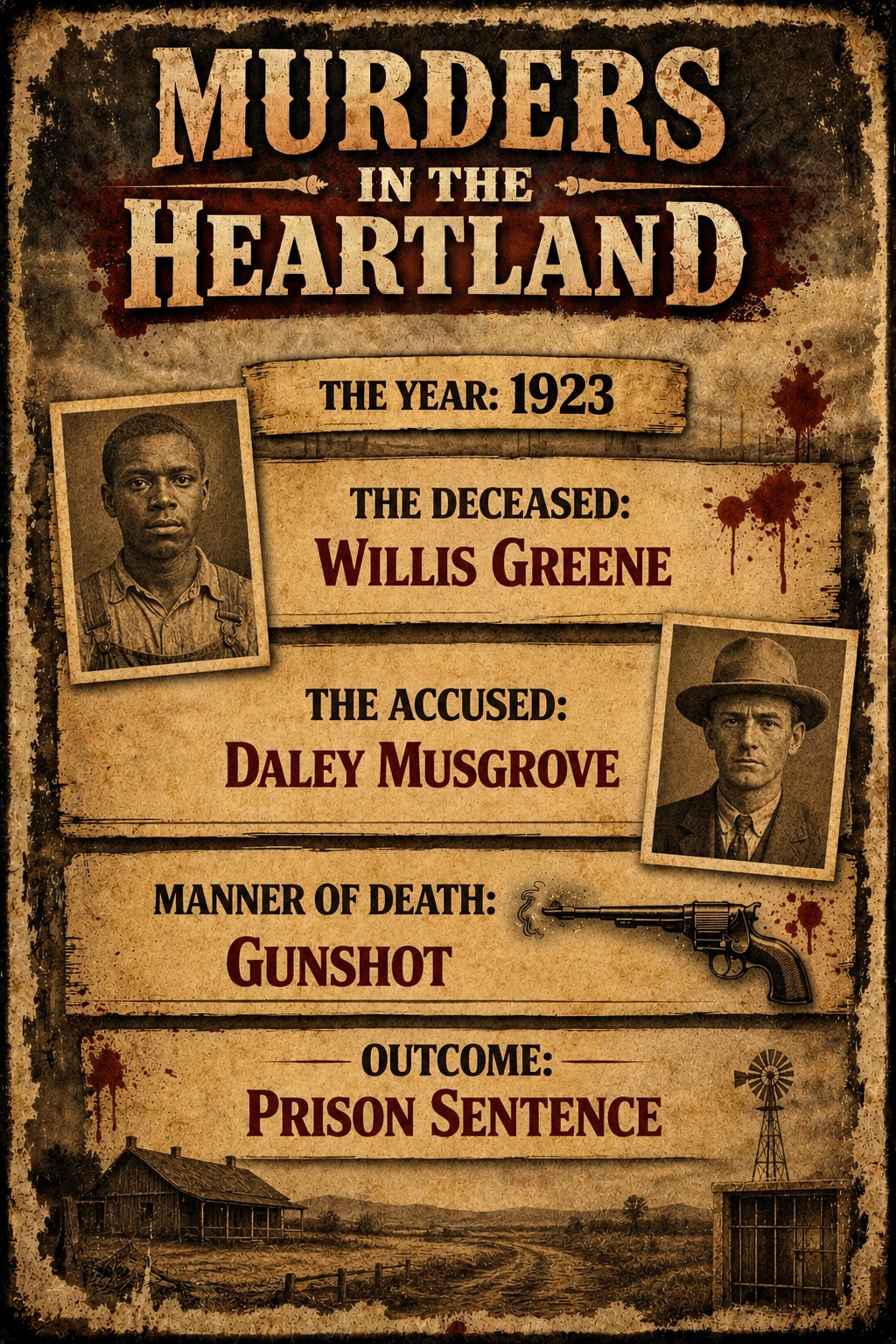
His name was Willis Greene. That much we know.
No birthdate. No census record. No marriage license. History lost the rest.
But on July 12, 1923, Greene was walking north on Big Ridge Road, east of Foster Crossroads, alone. He was black, on foot, and heading toward the Kentucky line. Maybe he was passing through. Maybe he was trying to find work. Maybe he just didn’t have anywhere else to go.
What’s certain is this: he was warned.
Sherman Marcum, a farmer who lived on Big Ridge, saw Greene walking the road and told him to turn back. Told him it wasn’t safe. Not there. Not then.
Willis Greene thanked him and kept walking.
Some men are like that. Stubborn with purpose, maybe. Or maybe just too tired to be afraid. Sherman Marcum watched him go and felt that coldness linger, the way it does when you know something is already in motion and there isn’t a thing left to be done about it.
***
Waiting further up the road was Daley Musgrove. Dale, as folks called him.
He’d served in the war. Fought in Europe, came home different. Everyone said so. Some said he was off. Others said he was just mean. Either way, he was dangerous.
What brought Greene and Musgrove together that day isn’t known for sure. But family accounts passed down through the years say Musgrove believed — claimed, anyway — that Greene was a wanted man. That there was a reward for his capture. Musgrove meant to collect.
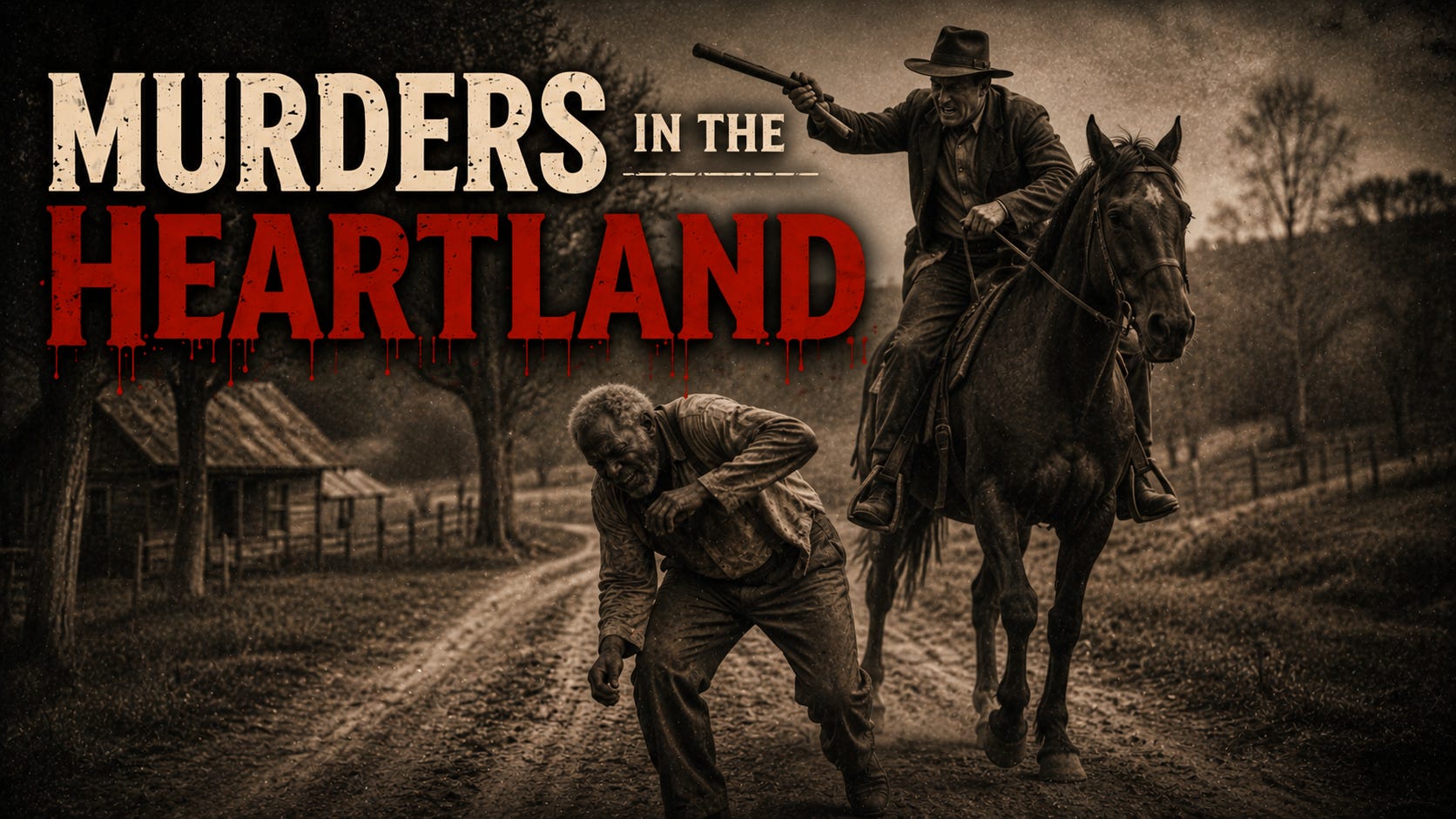
He found Greene at Foster Crossroads. Musgrove was on horseback, carrying a hickory stick. Greene, still on foot, was shoved ahead like cattle. The horseman drove him north toward Oneida, beating him with every step.
They climbed the ridge that afternoon, sun bearing down, sweat and blood slick on the old man’s skin.
At a narrow stretch of the road, a curve that hugs a bluff line, Willis Greene collapsed.
So Dale Musgrove pulled a gun and shot him dead.
The sound of that gunshot rolled out across the Tennessee hills and was absorbed by the trees and the heat and the silence of that place, and then there was nothing. Just a dead man on a lonely road, and a living one deciding what to do next.
***
Hillery Marcum found him on the way back from Oneida, his wagon still smelling of fresh lumber. Esau Foster was with him. The two men looked at each other over Greene’s body and reached an unspoken agreement, the way good men sometimes do in the face of something that can’t be undone. They spent the night there, by the road, keeping watch. Keeping darkness at bay — the animal kind, at least. The human kind had already done its work.
The next morning, the Marcum family built a casket out of yellow poplar and buried Willis Greene by the side of Big Ridge Road, near enough to where he fell.
There was no preacher.
No songs.
No family.
Just the Marcums, a few neighbors, and a hole in the dirt.
They set a slab of homemade concrete into the ground, marking it with crude letters before it died.
NEGRO WILLIS GREENE.
That was it. No dates. No epitaph. No justice.
For decades after, Wallace and Charlie Marcum — Hillery’s sons — would return to clear the brush from Greene’s grave. Long after the world forgot him, they didn’t.
This is what good people do, quietly, without applause. They bear witness. They tend to the forgotten. They remember so the forgetting doesn’t win completely.
***
Someone talked. Someone pointed the finger at Dale Musgrove.
No one knows exactly how it happened. But enough people had seen him riding behind Greene. Enough people heard what he was doing.
Musgrove was arrested, tried, and convicted of first degree murder. A white jury sentenced him to 25 years of hard labor.
He appealed. He lost.
They shipped him to Brushy Mountain Penitentiary. Later, they moved him to Nashville. By 1930, he was still locked up, serving time.
And then, quietly, he was let out.
On July 2, 1932, Dale Musgrove was gunned down in Scott County.
Nine years, almost to the day, after the death of Willis Greene.
No one knows who pulled the trigger. No one remembers why. The death certificate didn’t elaborate. It simply said:
“Gunshot wound.”
Musgrove was buried just a mile from where Greene was killed, in Foster Crossroads Cemetery, surrounded by his people. He was 38.
The man who shot an old stranger in the road died just short of his own redemption arc.
***
Today, there are no statues. No plaques. No roadside markers. Just a homemade headstone, some fake flowers left by the living, and a story whispered through generations.
Willis Greene was murdered for being a black man in the wrong place, at the wrong time.
But that’s not the end of it.
Because someone stopped. Someone buried him. Someone gave him a name, etched in stone. And someone remembered.
And if you know where to look — off a curve in the ridge, in a cluster of trees, you’ll find his grave. Still there.
Waiting to be remembered again.
Editor’s Note: This is the thirteenth installment of Murders in the Heartland, the IH’s reimagined series covering particularly noteworthy murders that have been committed in Scott County through the years. In many instances, descendants of both the victims and the perpetrators still live in our community. The intent is not to reopen old wounds or to cast judgment, but to document past events that have an indelible impact on our community’s history. At the conclusion of the series, our book by the same name will be republished in a second, revised edition.
Thank you for reading. Our next newsletter will be The Daybreaker bright and early Monday morning. If you’d like to update your subscription to add or subtract any of our newsletters, do so here. If you haven’t yet subscribed, it’s as simple as adding your email address!
◼️ About the IH • IH Sports Network • The Encyclopedia of Scott County
◼️ Subscribe • Sponsor • Manage Your Account
◼️ Follow us on Facebook, Instagram, X/Twitter, YouTube
Our Newsletters:
• Monday morning: The Daybreaker (news & the week ahead)
• Tuesday: Echoes from the Past (stories of our history)
• Wednesday: Threads of Life (obituaries)
• Thursday evening: The Weekender (news & the weekend)
• Friday: Friday Features (beyond the news)
• Sunday: Varsity (a weekly sports recap)