

Murders in the Heartland: The Apple Orchard Killing
Newt Blevins said he killed Dick Hatfield because Hatfield intended to kill Blevins. But Hatfield told a different story before he died.


You’re reading Friday Features, a weekly newsletter containing the Independent Herald’s feature stories — that is, stories that aren’t necessarily straight news but that provide an insightful look at our community and its people. If you’d like to adjust your subscription to include (or exclude) any of our newsletters, do so here. If you haven’t subscribed, please consider doing so!
Today’s newsletter is sponsored by First National Bank. Since 1904, First National Bank has been a part of Scott County. First National is local people — just like you. Visit fnboneida.com or call (423) 569-8586.

The Apple Orchard Killing
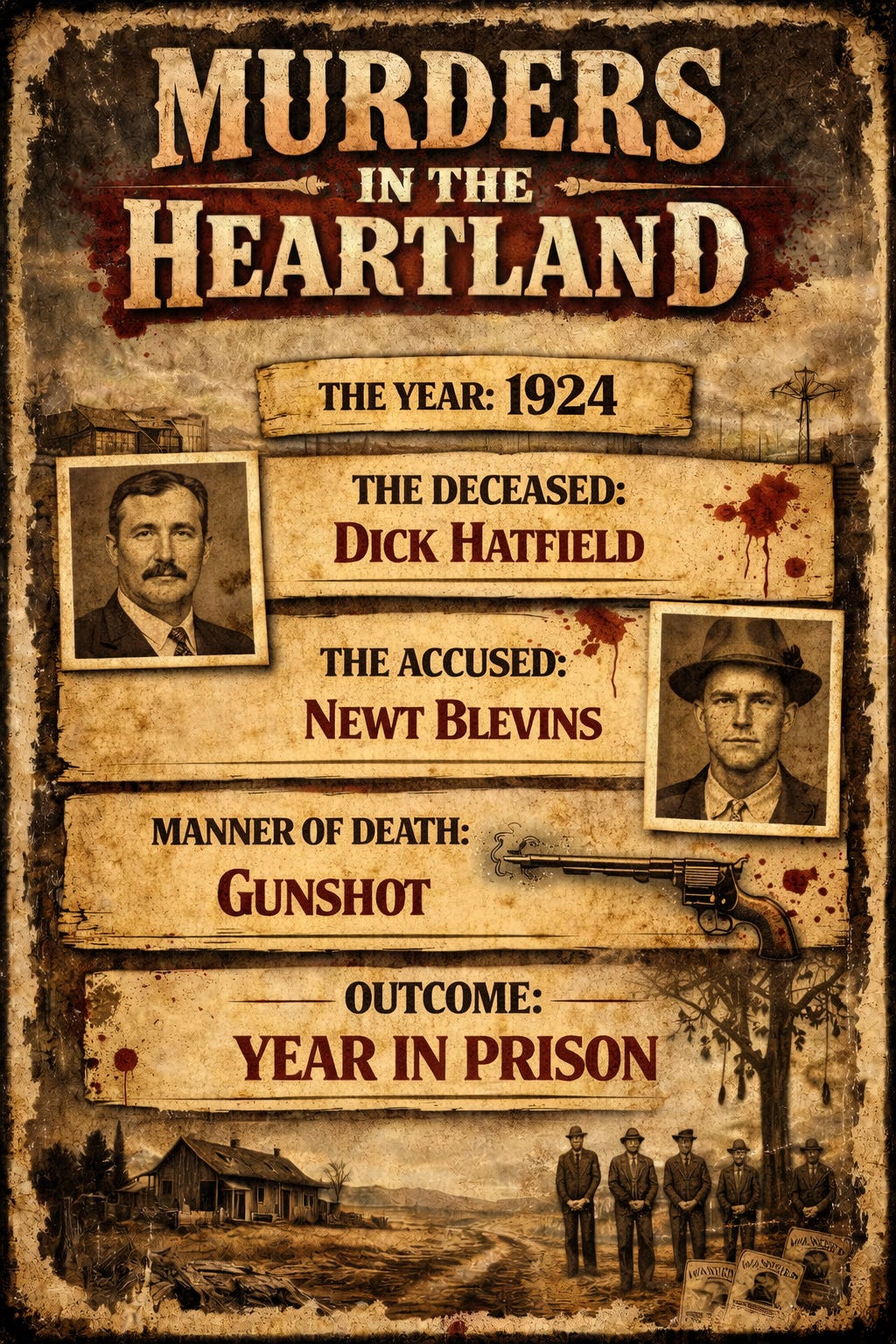
Station Camp – August 27, 1924
“I didn’t think anyone would have cared for the children getting apples.”
That’s what Newt Blevins claimed he told Dick Hatfield in the waning summer heat of 1924. That was right before Hatfield called him a “damn liar” and came at him with a knife. Again, that’s what Newt claimed.
What followed was a scuffle, then a gunshot. By the time the dust had settled, Dick Hatfield lay dying in the dirt beside Newt’s porch. The law called it murder. Newt called it self-defense.
A jury, apparently unsure what to believe, landed somewhere in the middle – convicting Blevins of involuntary manslaughter and sending him to prison for a single year. But was it mercy, or was it a miscarriage of justice?
One thing’s for sure: the killing started over something as simple – and as American – as apples.
***
John Newton Blevins, born in 1875, came from rugged Appalachian stock. His blood ran thick with the history of the Big South Fork region. He was the grandson of pioneers who’d carved out a life in the wilderness long before roads or lawmen ever reached that far. One ancestor, Richard Harve Slaven, was the first white settler in the No Business Creek area. Another, Jonathan Blevins, may have been one of the first to settle on Station Camp Creek.
But Newt Blevins was no frontier hero. He was a man worn down – crippled in one leg and one hand, rail-thin at a hundred and forty-five pounds, and struggling to raise eight children alongside his wife, Amanda Smith Blevins. He walked with a limp and lived in constant pain, a broken body housing a sharp mind that hadn’t yet dulled.
And if his neighbors thought he was as stubborn as a mule, so be it. Mountain men are supposed to be.
***
William Clayburn “Dick” Hatfield had been born in 1861 – a Valentine’s baby – son of William Riley Hatfield and, some said, kin to the infamous Devil Anse Hatfield of West Virginia feud fame. This branch of the family, as the story went, had fled the bloodshed, crossing into Tennessee in search of peace.
They didn’t find it.
In 1892, Dick’s father was shot and killed during a riverbank quarrel on the Big South Fork. Decades later, Dick followed the same path, though this time the fight wasn’t over land or legacy – just apples.
After a stint in Oklahoma and the tragic death of his wife, Vicy, Dick had come back to Station Camp alone. His children stayed out west. He remarried, maybe. Records suggest a match with Poppie Litton Blevins, though if it happened, she never took his name. Folks still called her Poppie Blevins, even after he died.
***
It started with kids – like trouble often does. Blevins’ children, along with a few others, wandered into Hatfield’s orchard and helped themselves to a few apples.
Nothing serious. Just kids being kids, or so Newt thought. But Dick Hatfield didn’t see it that way.
He filed a complaint with the local constable and schoolteacher, Ike King. Word came back to Newt, who returned the apples and likely figured that was the end of it.
It wasn’t.
According to District Attorney W.H. Swiggart, Newt resented Hatfield’s complaint – saw it as an insult to his family and his name. Whatever bitterness Newt felt, it simmered quietly until August 27.
That was the day the two men met at High Point, near Oneida. That was the day Newt invited Dick home for dinner.
***
What followed could have passed for neighborly. Hatfield came into Blevins’ modest home, sat at his table, and shared a meal with his family. The old mountain code – hospitality above all else – seemed to hold.
But not for long.
After dinner, the two men stepped onto the porch. It was there, amid the hush of the forest and the far-off whinnies of horses, that the apple incident came up again. Accusations flew and words grew sharp.
Then the knife came out.
What happened next depends on who you ask.
***
According to Hatfield, who gave his statement before dying, Blevins started the fight. He said hew as getting ready to leave when Newt raised hell about the apples again. Hatfield admitted to drawing his knife, but only after Newt came at him with a chair.
Blevins’ version? Completely different.
He said he made a casual comment – “I didn’t think anyone would have cared for the children getting apples” – and Hatfield exploded, calling him a liar and lunging at him with the knife. Newt barely had time to react, he said. He shoved a chair between them and still took a slash to the chest.
According to Newt, as he staggered for his gun, Hatfield grabbed Mandy, who was holding their baby. By the time Newt returned, Dick had let go and was making for his horse.
That’s when the rifle cracked.
***
“I saw Blevins coming with the gun and I run,” Hatfield told Marion Marcum. “I aimed to get to the horse and get away.”
But he didn’t make it. Witnesses said Newt fired once under the horse, striking Dick in the side. Hatfield collapsed trying to reach the barn.
A neighbor, Lora Smith, later asked Newt why he did it.
“He cut me with a knife, and I aimed to kill him,” Newt replied.
***
The jury didn’t buy it as self-defense. But neither did they agree with the state’s charge of first-degree murder.
Instead, they split the difference: involuntary manslaughter. One year in jail.
The prosecution wasn’t pleased. Swiggart called it a “very merciful verdict,” arguing that Blevins had gone too far when he “got his rifle and hunted Hatfield down while he was trying to get away.”
The defense said the jury wasn’t lenient enough. They pointed to Newt’s disability, the wound on his chest, and the threat to his wife and child.
“This killing could not be involuntary manslaughter,” they argued. “The evidence shows a crippled man defending his home, his wife, and his life.”
But an appellate court sided with the jury. The verdict stood.
***
Newt Blevins served his time in the old Scott County Jail in Huntsville. He walked free in 1926, a man hardened by captivity and haunted by the blood that stained his porch steps.
Two years later, justice came calling again.
Newt and Mandy were out rounding up cattle near their home when a bullet found him. Just like Hatfield before him, Newt dropped where he s stood. This time, no arrest was made. No trial. No conviction.
Just silence. Oh, there were suspicions about who was responsible. Still are, handed down to the kids of those who lived at Station Camp, and kids’ kids. But no proof.
***
In the years that followed, the killing of Dick Hatfield and the death of Newt Blevins faded into local memory – not forgotten, but folded into the long, complicated fabric of life in the Cumberland Mountains. There were no memorials, no markers beyond Dick’s weatherworn stone that bears his name at Coffey Cemetery (which is more than what Newt got when he was buried in an unmarked grave near his home). Just two men, both proud and flawed, caught in a moment that spiraled too far out of control.
The apple trees that sparked it all grew old and bare. The families scattered – Hatfield’s bloodline lingering in Oklahoma, Blevins’ children forging quiet lives of their own in the hills and hollows of East Tennessee.
And life went on.
In Station Camp, folks still tell the story from time to time – less as a warning, more as a curiosity. A reminder that justice is never as clean as the law, and that in a place where pride runs deep and tempers run hot, even something as simple and as all-American as an apple can change everything.
Editor’s Note: This is the tenth installment of Murders in the Heartland, the IH’s reimagined series covering particularly noteworthy murders that have been committed in Scott County through the years. In many instances, descendants of both the victims and the perpetrators still live in our community. The intent is not to reopen old wounds or to cast judgment, but to document past events that have an indelible impact on our community’s history. At the conclusion of the series, our book by the same name will be republished in a second, revised edition.
Thank you for reading. Our next newsletter will be The Daybreaker bright and early Monday morning. If you’d like to update your subscription to add or subtract any of our newsletters, do so here. If you haven’t yet subscribed, it’s as simple as adding your email address!
◼️ About the IH • IH Sports Network • The Encyclopedia of Scott County
◼️ Subscribe • Sponsor • Manage Your Account
◼️ Follow us on Facebook, Instagram, X/Twitter, YouTube
Our Newsletters:
• Monday morning: The Daybreaker (news & the week ahead)
• Tuesday: Echoes from the Past (stories of our history)
• Wednesday: Threads of Life (obituaries)
• Thursday evening: The Weekender (news & the weekend)
• Friday: Friday Features (beyond the news)
• Sunday: Varsity (a weekly sports recap)