



You’re reading Friday Features, a weekly newsletter containing the Independent Herald’s feature stories — that is, stories that aren’t necessarily straight news but that provide an insightful look at our community and its people. If you’d like to adjust your subscription to include (or exclude) any of our newsletters, do so here. If you haven’t subscribed, please consider doing so!
Today’s newsletter is sponsored by First National Bank. Since 1904, First National Bank has been a part of Scott County. First National is local people — just like you. Visit fnboneida.com or call (423) 569-8586.


The death of the baseball star
Helenwood, Tennessee – July 5, 1906
Sam Parker stepped off the train into the afternoon heat and never saw it coming.
He’d been playing baseball in Oneida that Thursday – just a summer game with friends – and caught the Cincinnati-Southern back to Helenwood. He was twenty-six years old, a lawyer with a future, the kind of young man people pointed to as an example of what you could become if you worked hard and kept your head on straight.
Judge James E. Fulton was waiting on the platform with a double-barreled shotgun.
He fired both barrels into Parker’s stomach while his own teenage son watched.
Sam Parker – star athlete at the University of Tennessee, promising attorney, son of one of Scott County’s most powerful political families – died on the depot platform before the doctor from Somerset could even get there.
Fulton’s excuse was that Parker had seduced his wife.
Everyone denied it. Parker denied it with his dying breath. Fulton’s wife, who’d already left him by that point, denied it too.
Nobody believed him. But it didn’t matter. Sam Parker was still dead.
***
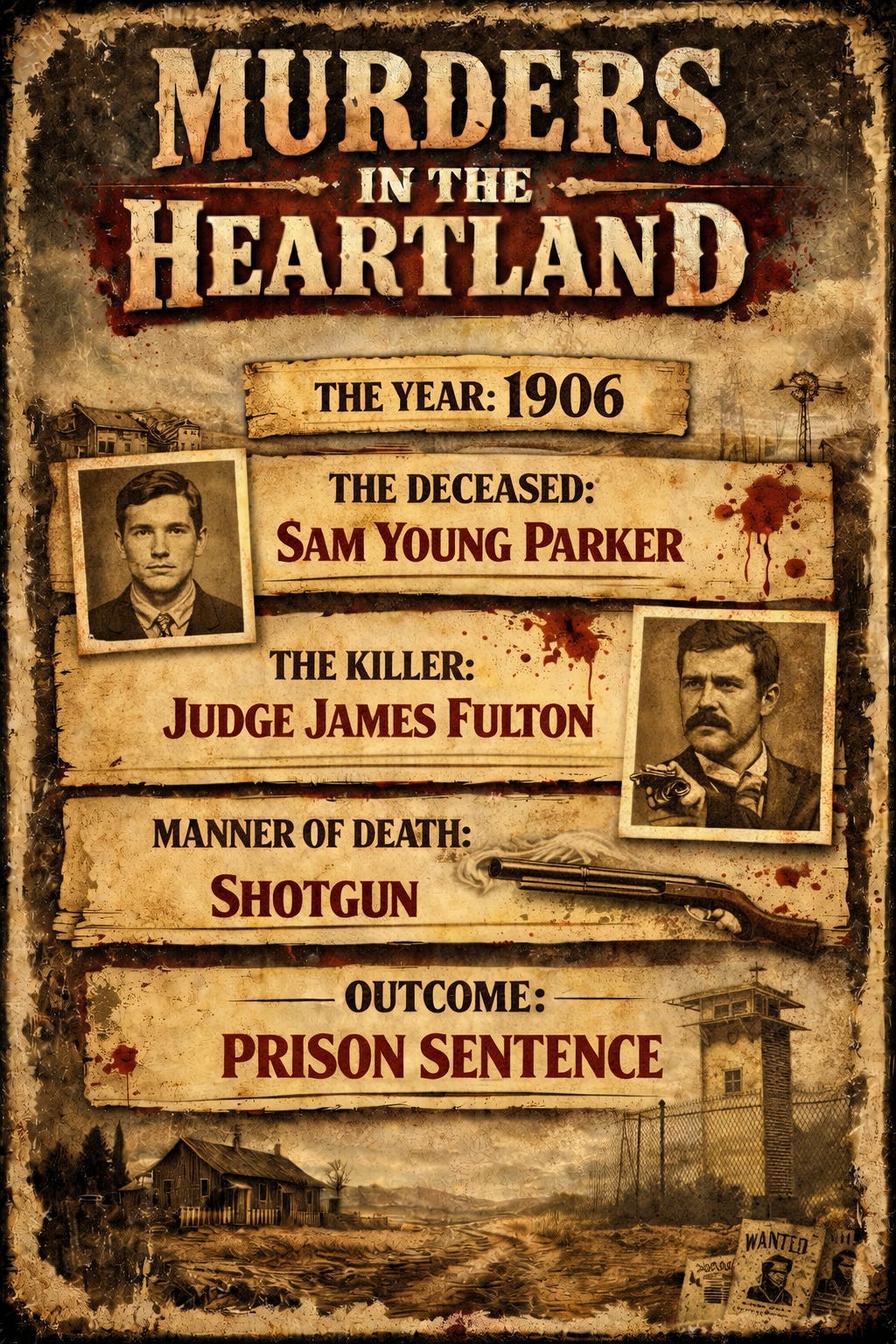
Samuel Young Parker was born into the kind of family that made things happen in Scott County.
His father, James Crawford Parker – J.C. to everyone who knew him – came from frontier stock down near Robbins and worked his way up to county judge and eventually state senator. He was Scott County’s first superintendent of schools. J.C.’s wife, Mary Burke Parker, ran the post office in Helenwood. They had nine children, and Sam was the one who stood out.
He was smart like his father. Studied like his father. But it was athletics where he really shined.
At the University of Tennessee, they called him “Judge” – partly because he was studying law, but mostly because of the way he carried himself. He played football, basketball, and baseball, and excelled at all three. The newspapers called him “the best all-around athlete” at UT. In 1904, he helped the football team beat Alabama for the first time, which started a rivalry that’s still going strong today. That same year, he made All-Southern as a fullback.
Parker was also the ace pitcher on the baseball team. Pro teams came calling, but he turned them down. He wanted to come home and practice law, to make a difference in his community.
He was twenty-six and just getting started when Judge Fulton killed him.
***
The shooting happened in broad daylight on the depot platform. No hiding, no sneaking around. Fulton just stood there and waited for Parker’s train to arrive, then raised the shotgun and pulled both triggers.
They sent a special train to Somerset to fetch a doctor, but there was no saving him.
Fulton surrendered to the authorities and was taken to Knoxville for a hearing. His defense was temporary insanity brought on by drink and cigarettes. He said he’d snapped. His lawyers brought in doctors who swore his mental state was unsound. Some people said they’d seen him tearing up money on the streets before the shooting, muttering to himself.
The prosecution didn’t buy it. A man named Church Pemberton – a respected citizen – testified that Fulton had waited calmly at the depot for over an hour before Parker’s train arrived. He wasn’t drunk or crazy. He knew exactly what he was doing.
J.C. Parker was devastated that Fulton had turned on his son. Fulton had been a family friend and had even boarded at the Parker home in Helenwood. Judge Parker sent three of his daughters to plead with Fulton’s attorney. The lawyer was so moved by their appeal that he dropped Fulton as a client and refused to represent him anymore.
The first trial ended with a hung jury. The second one stuck. Fulton was sentenced to ten years in prison.
He served ten months.
Governor Malcolm Rice Patterson commuted his sentence. The man who murdered Sam Parker in cold blood walked free.
***
Ten years later, in 1917, Judge James E. Fulton was the city attorney for Oneida.
When the town’s newspaper, the Scott County News, printed an editorial that angered him, he threatened to kill the editor, J.E. Bell. For two weeks, Fulton stalked Bell around town, making his intentions clear.
Finally, they met face to face in Judge W.H. Potter’s office.
This time, Bell was armed.
He pulled a derringer and shot Fulton in the spine. Fulton died in a Knoxville hospital a few days later – almost exactly eleven years after he’d killed Sam Parker.
Bell was convicted of voluntary manslaughter. The governor pardoned him almost immediately.
***
J.C. Parker never recovered from his son’s death.
He was already sick, already grieving the loss of his wife, Mary, and a teenaged son who’d died earlier. Sam’s murder was the final blow. He died three weeks after the shooting, broken-hearted.
Four members of the Parker family – J.C., Mary, Sam, and his nineteen-year-old brother, Burdette – are buried side-by-side at Helenwood Cut Cemetery.
The rest of the family scattered.
John, Sam’s younger brother, died in Kentucky in 1938 of heart disease. Luther went to Chicago and died there in 1936. Ella, one of the three daughters who’d pleaded with Fulton’s attorney, died of Spanish flu in 1918. Ida died in Kentucky in 1924, just before Thanksgiving. Belle made it to Memphis and died in 1954.
The Parker family, once among the most powerful in Scott County, was broken and scattered.
***
More than a century has passed since that July afternoon on the depot platform.
The depot is gone now. Helenwood barely remembers the Parkers or the man who killed their most promising son. But the story’s still there if you know where to look for it – in the cemetery at Helenwood Cut, or in old newspaper clippings.
Sam Parker was twenty-six years old. He’d just finished a baseball game. He stepped off a train and died before he hit the ground.
His killer served ten months and walked free.
That’s all there is to it. That’s the whole story.
Sometimes justice works the way it’s supposed to. Sometimes it doesn’t. In Scott County in 1906, it didn’t. And by the time Judge Fulton got what was coming to him eleven years later, the Parker family was already gone – scattered to Chicago and Kentucky and Memphis, or buried at the Helenwood Cut.
The mountains don’t forget. They never do.
They just keep standing there, watching families rise and fall, watching men kill each other over things that don’t matter, watching the trains come and go from depots that eventually get torn down and replaced with nothing.
That’s the way it seemed to go in these hills as the 1800s rolled into the 1900s. Maybe it always has been.
Editor’s Note: This is the sixth installment of Murders in the Heartland, the IH’s reimagined series covering particularly noteworthy murders that have been committed in Scott County through the years. In many instances, descendants of both the victims and the perpetrators still live in our community. The intent is not to reopen old wounds or to cast judgment, but to document past events that have an indelible impact on our community’s history. At the conclusion of the series, our book by the same name will be republished in a second, revised edition.
Thank you for reading. Our next newsletter will be The Daybreaker bright and early Monday morning. If you’d like to update your subscription to add or subtract any of our newsletters, do so here. If you haven’t yet subscribed, it’s as simple as adding your email address!
◼️ About the IH • IH Sports Network • The Encyclopedia of Scott County
◼️ Subscribe • Sponsor • Manage Your Account
◼️ Follow us on Facebook, Instagram, X/Twitter, YouTube
Our Newsletters:
• Monday morning: The Daybreaker (news & the week ahead)
• Tuesday: Echoes from the Past (stories of our history)
• Wednesday: Threads of Life (obituaries)
• Thursday evening: The Weekender (news & the weekend)
• Friday: Friday Features (beyond the news)
• Sunday: Varsity (a weekly sports recap)