


You’re reading Friday Features, a weekly newsletter containing the Independent Herald’s feature stories — that is, stories that aren’t necessarily straight news but that provide an insightful look at our community and its people. If you’d like to adjust your subscription to include (or exclude) any of our newsletters, do so here. If you haven’t subscribed, please consider doing so!
Today’s newsletter is sponsored by First National Bank. Since 1904, First National Bank has been a part of Scott County. First National is local people — just like you. Visit fnboneida.com or call (423) 569-8586.


Murders in the Heartland: The Hanging
Huntsville, Tennessee – May 17, 1895
By noon on execution day, Huntsville looked like a county fair.
Two thousand people packed into the town square. They came in wagons, on horseback, and on foot. Mothers held their children’s hands. Fathers hoisted sons onto their shoulders for a better view. Vendors worked the crowd, hawking peanuts and lemonade, calling out their prices over the noise. The air had that strange festival energy – excited, expectant, and buzzing.
But there were no games, no parade floats, and no ribbon competitions.
The crowd had come to watch a man die.
Mike King stood on the gallows in the center of town, weeping. His wife sat beside him with their infant daughter in her arms. He was twenty-three years old, missing one hand, and condemned to hang for murdering a schoolteacher who’d taught him to write. This would be the first – and only – legal hanging in Scott County’s history.
It started with fifty-four dollars, a borrowed bed, and a friendship that turned to murder.
***
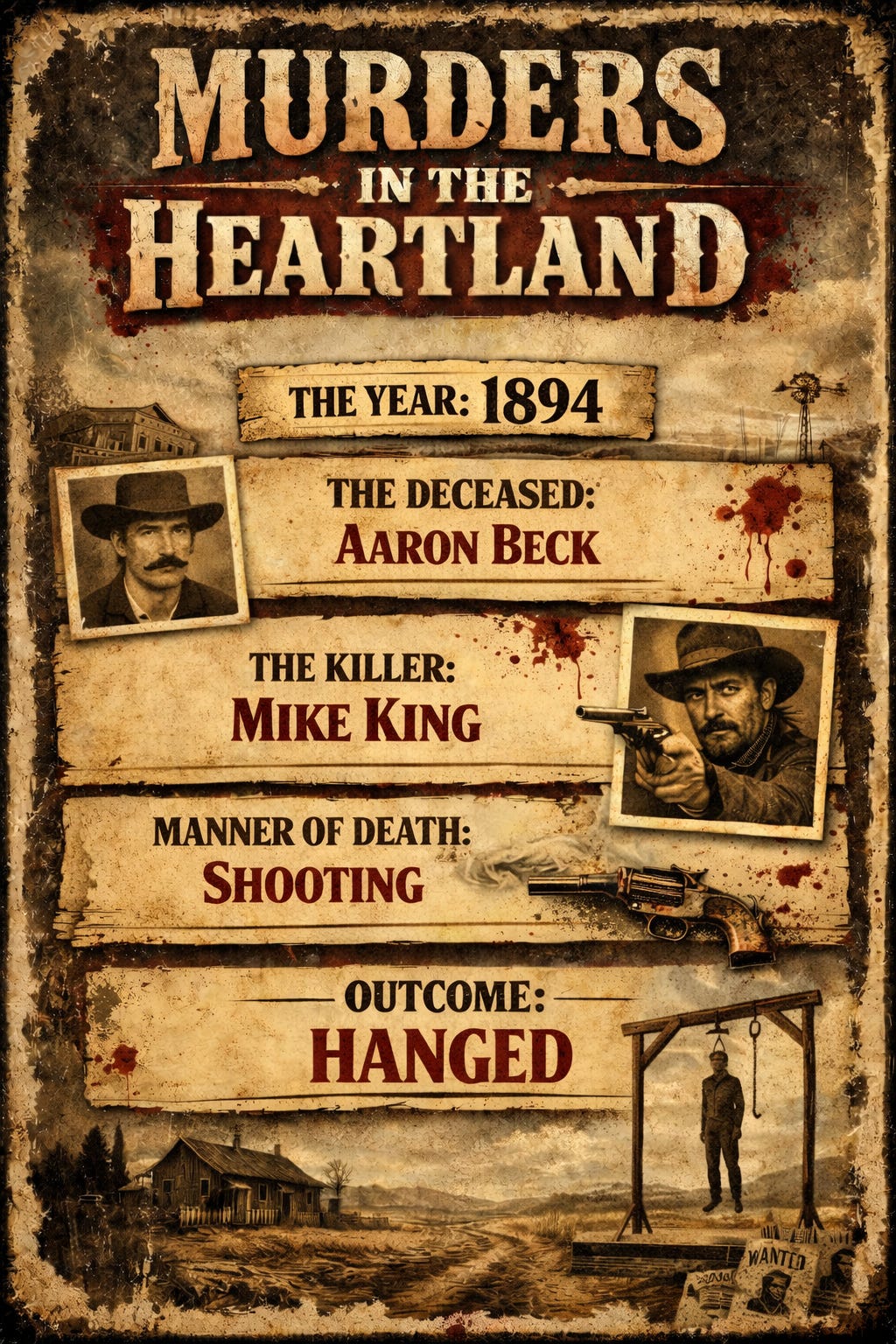
Mike King wasn’t the type you’d expect to kill anyone.
Born in 1872 along the Tennessee-Kentucky line, he’d lived his whole life in the coal camps and mining towns near the border. His family was respectable, and his own name was clean. He had a wife named China Cordell and a baby girl, Essie. A newspaper would later note that he “always bore a fair reputation – until the time of the murder.”
He had only one hand. How he lost the other, nobody remembers anymore. He worked odd jobs when he could find them and relied on people’s kindness when he couldn’t.
That’s probably how he met Aaron Beck.
Beck was forty-six, a writing teacher from Russell County, Kentucky, who’d come down to Scott County to teach in the coal camps around Paint Rock, just east of Oneida. The newspapers said he was gentle and well-liked – a quiet man who helped people when they needed it.
He took an interest in King. Maybe he saw something worth encouraging. There was an age gap between them, but they became friends. Beck taught King to write, and even helped him prepare to teach a class of his own.
Somewhere along the way, though, something changed in King. Admiration twisted into something else. Friendship wasn’t enough anymore.
He wanted Beck’s money.
***
According to King’s confession, he started thinking about killing Aaron Beck in the middle of December 1894.
Beck had money. More than a schoolteacher had any right to, King figured. He saw an opportunity and began to plan.
On December 20, he waited all day at Tunnel Hill – a remote spot along the railroad that ran from Oneida to the Paint Rock mines. He brought a rifle, and planned to ambush Beck when he came back from teaching.
Beck never showed.
Three days later – the day before Christmas Eve – King found Beck in Oneida and convinced him to come back to Winfield for the night. They got to King’s house late and went straight to bed without supper. King’s wife was away, visiting relatives in Lancing.
Around eleven o’clock, King got up. He retrieved a .38-caliber pistol and shot Beck in the head while the schoolteacher slept.
Beck didn’t die right away. He stirred and flailed. King grabbed a hatchet and finished the job.
He found fifty-four dollars in Beck’s pockets – about nineteen hundred in today’s money.
King dragged the body through the woods and dumped it in a shallow pit behind his house where a tree had been uprooted. He burned Beck’s clothes, scrubbed the blood off the floors, and tried to forget what he’d done.
When his wife came home from Morgan County, King told her their house was haunted. They needed to leave immediately, he said. Maybe he was worried about evidence. Or maybe guilt was eating him alive.
Either way, suspicion caught up with him soon enough.
***
Nearly a month passed. Nobody missed Beck at first. People figured he’d gone home to Kentucky for the holidays.
But whispers started spreading about Mike King’s sudden spending. The one-handed man who’d always been poor suddenly had money. Not just enough to get by – enough to show off.
On January 20, 1895, the truth came out.
The family of Hannibal Ross, a local farmer, found Beck’s body. Some versions say that a young boy gathering firewood spotted a hand protruding from the frozen ground. Others say the smell led them there. Either way, Ross found King and held him at gunpoint.
The body was hauled back to King’s house for an inquest. King was made to help carry the man he’d murdered.
Sheriff John Goad was called in. At first, King said another man had shot Beck and he’d only “finished the job.” But after they took him to the jail in Wartburg – far enough away that an angry mob couldn’t get to him – King confessed everything.
He’d lured Beck home. Waited until he fell asleep. Killed him. Took fifty-four dollars.
***
King went on trial in Huntsville on March 20, 1895. Judge Rodgers came up from Loudon to preside. W.H. Potter prosecuted. King didn’t fight the charges, and there would be no appeal.
His execution was set for Friday, May 17. To keep things calm before the hanging, they held King in Chattanooga until the day of the hanging.
***
By sunrise on execution day, people were already flooding into Huntsville. The hanging was treated like entertainment. Vendors sold peanuts, lemonade, and bologna sandwiches. Children climbed on their fathers’ shoulders for a better view. Some men rode horses through the streets, yelling and firing pistols in the air.
“The people made it a gala occasion,” one reporter wrote. “It was a regular picnic.”
For Sheriff John Goad, it was anything but.
Goad wasn’t a hard man. The job of ending another man’s life tormented him. He even thought about resigning rather than go through with it.
King, facing death, told him plainly: “This is your duty. You must perform it.”
Mike King wasn’t defiant. He was broken. His wife, China, sat beside him on the gallows with their baby in her arms. They held each other while Rev. George Cecil preached a funeral sermon to the crowd.
When it was time for the King to speak, he addressed the masses, tears running down his face. He said God had forgiven him and begged the young men listening not to follow his path.
“It was the saddest scene ever witnessed and there was not a dry eye in the jail enclosure,” a reporter wrote. “Many wept copiously at the piteous pleas and cries of the poor woman and the innocent tears of the poor child.”
Sheriff Goad tried to say something, but couldn’t get the words out.
At 12:30 p.m., the trap dropped.
At 12:37 p.m., Mike King was dead.
***
The rope they used had already hanged one man – a convicted killer named Buddy Wooten in Chattanooga four months earlier. Now it had claimed its second.
King’s body was returned to Winfield and buried at Isham Cemetery. Where Aaron Beck was buried, nobody knows.
China King, the young widow who’d clutched her baby through her husband’s final hour, eventually remarried – but not for thirty years. She had several children with a man named John Anderson before they finally wed in 1937. She died in 1941 and was buried beside him at Chitwood Cemetery.
Their daughter Essie – who’d sat silent in her mother’s arms during the execution – grew up, married a preacher, and raised eight children. She died in 1979, buried in Revelo, Kentucky.
As for Sheriff Goad, he finished his term and left law enforcement for good. He became the Scott County Trustee, then the Circuit Court Clerk, and eventually the superintendent of the Oneida Hosiery Mill. But for all his titles and years of service, he carried one distinction above all others.
He was the only sheriff in Scott County’s history to legally hang a man.
And it haunted him until the day he died.
Editor’s Note: This is the fifth installment of Murders in the Heartland, the IH’s reimagined series covering particularly noteworthy murders that have been committed in Scott County through the years. In many instances, descendants of both the victims and the perpetrators still live in our community. The intent is not to reopen old wounds or to cast judgment, but to document past events that have an indelible impact on our community’s history. At the conclusion of the series, our book by the same name will be republished in a second, revised edition.
Thank you for reading. Our next newsletter will be The Daybreaker bright and early Monday morning. If you’d like to update your subscription to add or subtract any of our newsletters, do so here. If you haven’t yet subscribed, it’s as simple as adding your email address!
◼️ About the IH • IH Sports Network • The Encyclopedia of Scott County
◼️ Subscribe • Sponsor • Manage Your Account
◼️ Follow us on Facebook, Instagram, X/Twitter, YouTube
Our Newsletters:
• Monday morning: The Daybreaker (news & the week ahead)
• Tuesday: Echoes from the Past (stories of our history)
• Wednesday: Threads of Life (obituaries)
• Thursday evening: The Weekender (news & the weekend)
• Friday: Friday Features (beyond the news)
• Sunday: Varsity (a weekly sports recap)