



You’re reading Friday Features, a weekly newsletter containing the Independent Herald’s feature stories — that is, stories that aren’t necessarily straight news but that provide an insightful look at our community and its people. If you’d like to adjust your subscription to include (or exclude) any of our newsletters, do so here. If you haven’t subscribed, please consider doing so!
Today’s newsletter is sponsored by First National Bank. Since 1904, First National Bank has been a part of Scott County. First National is local people — just like you. Visit fnboneida.com or call (423) 569-8586.

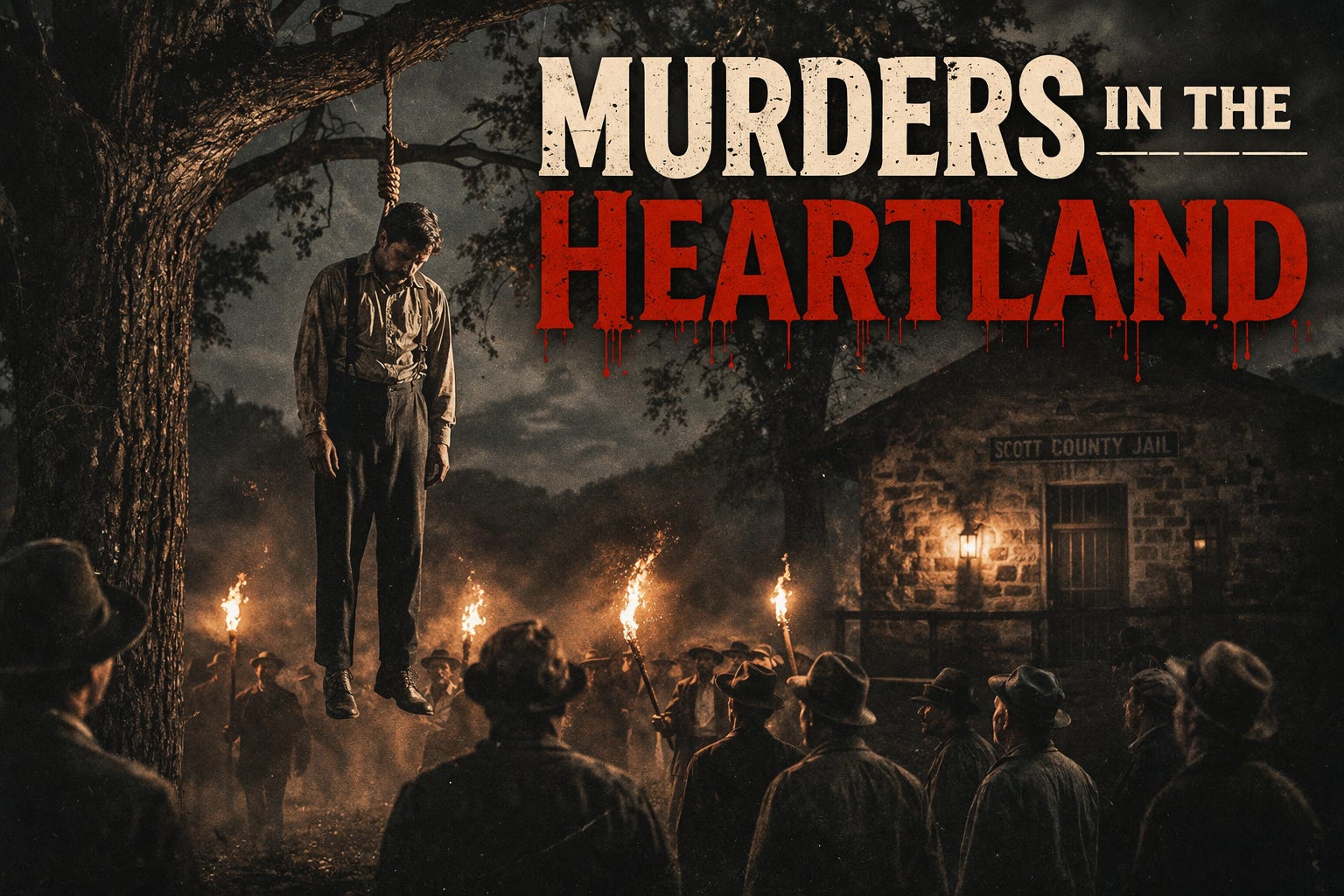
Huntsville, Tennessee – May 6, 1921
The doors to the old Scott County Jail creaked open around midnight. A cold wind moved through the iron bars and into the cramped cell where Berry Bowling sat alone. The boots echoing on the stone floor didn’t belong to lawmen. They belonged to masked men with shotguns and a verdict already decided.
As they dragged Bowling out of his cell, the wife of the jailer, James Mart Chambers, made a final plea.
“Pray, Berry!” Nancy Chambers cried out.
Berry turned his head slightly. “I can’t,” he said.
Those were the last words anyone ever heard him speak.
***
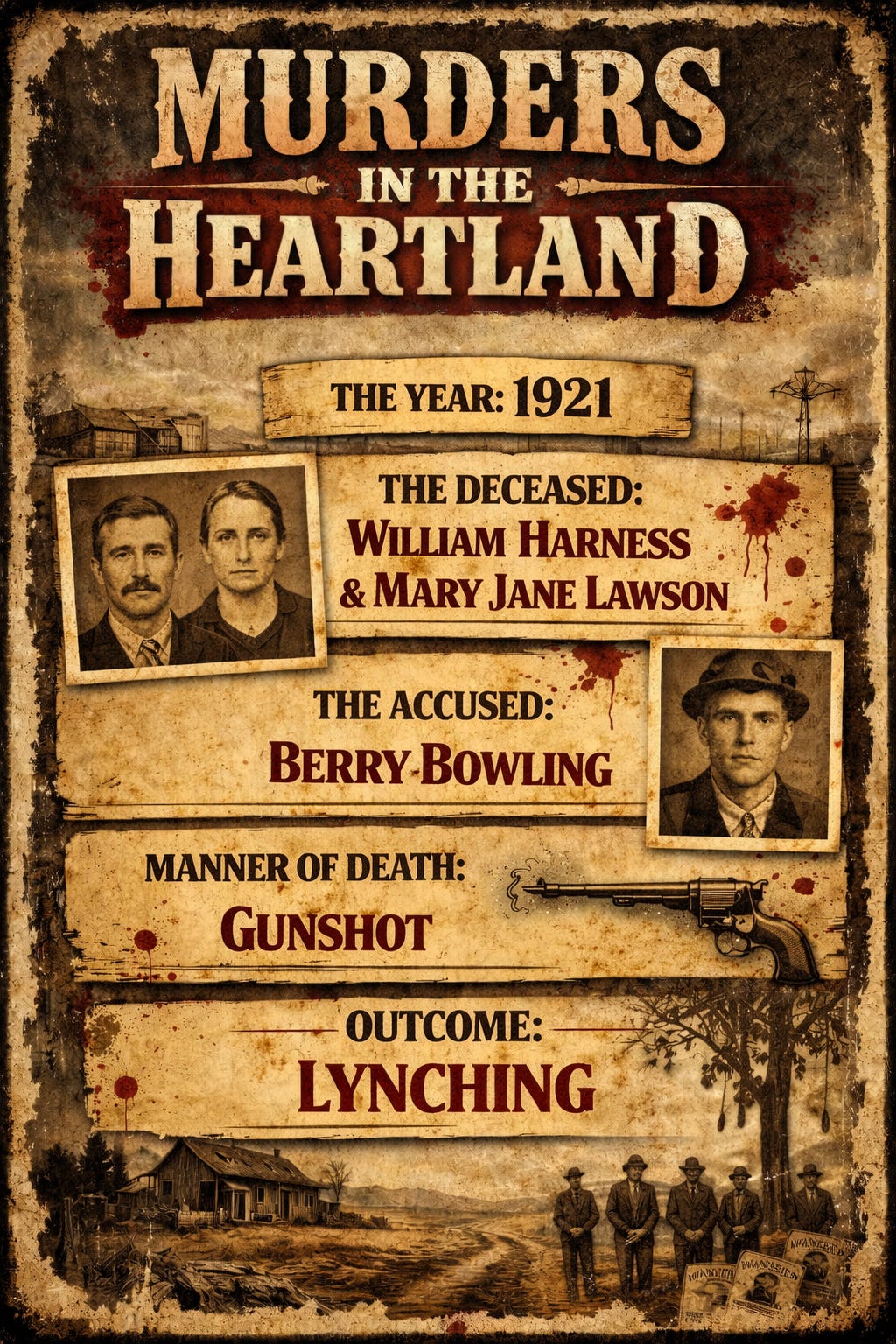
Back up a few months. Back up to the hills of Bull Creek, south of Huntsville, where this story started. It was the same little community where another double murder had led to the lynchings of two men more than 30 years earlier, after Elias Reynolds and Thomas Lloyd were accused of killing a woman and her teenage son.
This time, the killings started with William Harness. He was seventy-two years old, a Civil War veteran, patriarch of a large mountain family. He turned up dead, and the newspapers barely noted it. There was no statewide spectacle; no outrage. Just a quiet death in a strange place, and one man arrested: Berry Bowling, the dead man’s former brother-in-law.
Whatever the motive was, it’s been lost. Maybe it was land. Maybe it was an old grievance. The only thing people could agree on was that Mary Jane Harness had taken the stand and testified against Bowling, and he hadn’t taken it kindly.
Mary Jane Lawson had already seen hard times before any of this. She’d buried one husband – John Bowling, Berry’s older brother – and then married William Harness. Between her first marriage and her second, she had six children. William had ten from his first wife, Elvira Brown. It wasn’t an easy life, but it was hers.
She was thirty-three years old on the morning of May 3, 1921, when someone shot her dead in her home.
Some said it was revenge for her testimony. Others said it was rage. Either way, everyone in town knew who would be arrested. By the next day, Berry Bowling was behind bars in Huntsville.
The Associated Press was direct about it: “The testimony of Mrs. Harness was most incriminating, and this is believed by some to have led Bowling to kill her.”
That sealed it. Whether he pulled the trigger or not, Berry Bowling was a marked man.
***
By Saturday night, four days after Mary Jane’s murder, the mob arrived.
Fifty men, or twenty-five, or thirty – the newspapers couldn’t agree on the number, and that fact alone says something about how little anyone was paying attention to the details. Their faces were covered in black cloth – which suggests they knew, on some level, that what they were about to do wasn’t right. They told Mart Chambers they had a new prisoner to book. It was a lie, of course. When he opened the door, they shoved their way through.
“Berry,” one of them said, “we’ve come to bond you out.”
They laughed as they pushed him into the street.
Nancy Chambers followed them out in her nightclothes.
“Pray, Berry,” she begged. “Pray.”
“I can’t,” he said.
***
A white oak stood on River Junction Road, a mile from the jail. It was the kind of tree that stands by the roadside like a sentinel, has been there so long that it has become something more than a tree – a landmark that the road has grown around.
They threw a rope over a branch. When they hoisted Berry up, it snapped.
There’s an old notion – a mountain superstition – that a broken rope means something. It’s a sign to stop, to let the man go. But there’s no lawfulness in a lynch mob, and old notions don’t mean much to men who have already made up their minds.
They got a second rope.
When Berry Bowling was dead, they filled his body with bullets and left him hanging. A Nashville newspaper reported it plainly: “After he had apparently choked to death, the body was riddled with bullets and left hanging in the tree until Sunday morning when officers cut it down.”
His death certificate listed the cause of death as strangulation. In the space where the manner was recorded, someone wrote four words: “Hanged by a mob.”
***
Nobody was ever charged.
Sheriff Mitchell Phillips estimated twenty-five men were involved. The NAACP said fifty. The Nashville Bannerguessed thirty. Whatever the number, not one of them ever faced a jury.
Scott County, researchers would later document, had more lynchings than any other county in East Tennessee – seven in total. While lynching across the South was overwhelmingly used as a weapon of racial terror against black victims, in the remote hollows of Scott County the rope was applied more broadly. Berry Bowling was white, but his skin color didn’t save him. Because it was never about Berry’s skin color. It was about the death of his former sister-in-law, Mary Jane Harness.
The newspapers took notice, briefly. “Mob justice strikes again,” one headline read. Then the ink dried, and the story faded.
***
William Harness was buried in the cemetery at the head of Bull Creek, beneath a stone with no date of death. Mary Jane was buried beside him. And then, in what might be the strangest footnote to this whole grim story, Berry Bowling was buried there, too – the man accused of killing both of them, laid to rest within arm’s reach of his alleged victims.
Nobody seems to have planned it that way. It just happened.
Berry’s five children, all under twelve when he died, grew up fatherless. His youngest, Obis Bowling, lived until 1999. Mary Jane’s youngest daughter, Laura Mae, lived until 2016. Their descendants still live in those hills, still drive the same narrow roads, still pass that cemetery.
There’s no marker on Litton Covered Bridge Road – what used to be River Junction Road – where the oak tree stood. No plaque on the old jail. Nothing to say that any of this happened.
Just a cemetery. Just the three graves at the head of Bull Creek.
And a cold wind some nights through the trees.
“Pray, Berry.”
“I can’t.”
—
Editor’s Note: This is the ninth installment of Murders in the Heartland, the IH’s reimagined series covering particularly noteworthy murders that have been committed in Scott County through the years. In many instances, descendants of both the victims and the perpetrators still live in our community. The intent is not to reopen old wounds or to cast judgment, but to document past events that have an indelible impact on our community’s history. At the conclusion of the series, our book by the same name will be republished in a second, revised edition.
Thank you for reading. Our next newsletter will be The Daybreaker bright and early Monday morning. If you’d like to update your subscription to add or subtract any of our newsletters, do so here. If you haven’t yet subscribed, it’s as simple as adding your email address!
◼️ About the IH • IH Sports Network • The Encyclopedia of Scott County
◼️ Subscribe • Sponsor • Manage Your Account
◼️ Follow us on Facebook, Instagram, X/Twitter, YouTube
Our Newsletters:
• Monday morning: The Daybreaker (news & the week ahead)
• Tuesday: Echoes from the Past (stories of our history)
• Wednesday: Threads of Life (obituaries)
• Thursday evening: The Weekender (news & the weekend)
• Friday: Friday Features (beyond the news)
• Sunday: Varsity (a weekly sports recap)