

The Goads of Buffalo
At the Laxton Cemetery in the Buffalo community is a grave that some online sources purport to date to 1795, which would make it the oldest grave in Scott County if those reports are true.

You’re reading “Echoes in Time,” a weekly newsletter by the Independent Herald that focuses on stories of years gone by in order to paint a portrait of Scott County and its people. “Echoes in Time” is one of six weekly newsletters published by the IH. You can adjust your subscription settings to include as many or as few of these newsletters as you want. If you aren’t a subscriber, please consider doing so. It’s free!
Today’s newsletter is sponsored by the Scott County Chamber of Commerce. Since 1954, the Scott County Chamber of Commerce has advocated for a strong community by supporting stronger infrastructure and leadership.

The Goads of Buffalo
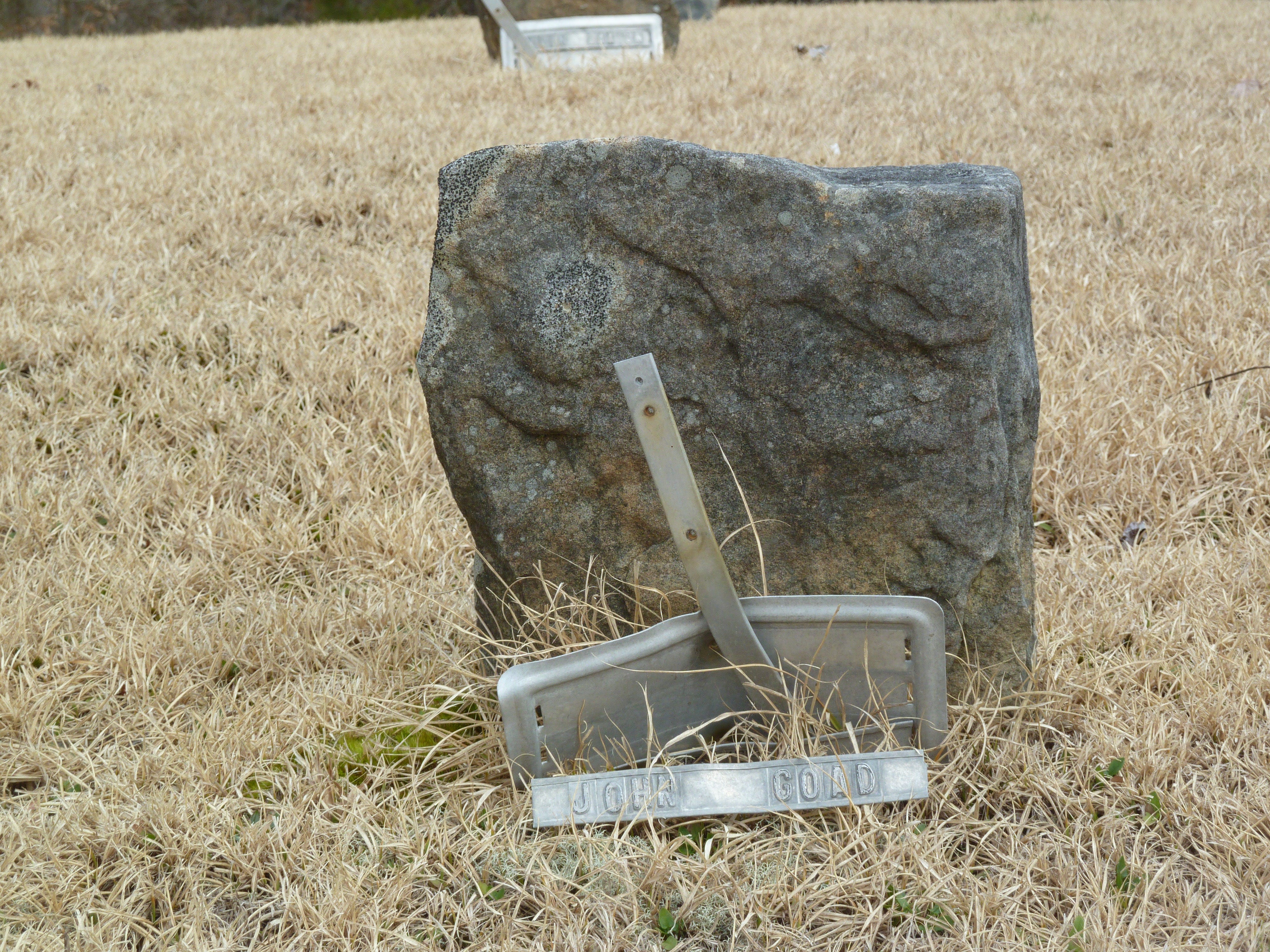
At the Laxton Cemetery in the Buffalo community, there are several Goads buried — 12 in all, nearly all of them with an uninscribed field stone marking their grave, and a plain funeral home marker that was added later.
Who were they?
The easiest answer is that they were tied to the Laxton family. Thomas Laxton, the forefather of all Laxtons in Scott County today, and one of the earliest settlers of Buffalo, married Elizabeth Goad. But who was she beyond that? And does her family tie to Scott County’s other Goad family, that of Revolutionary War veteran Abraham Goad, who settled on New River south of Huntsville?
Because the original stones at Laxton Cemetery were uninscribed, they provide no information on when these Goads lived and died. The funeral home markers, which came later (there was no such thing as funeral home markers in Scott County back in the 1800s), provide us with names but no dates.
One of the funeral home markers at Laxton Cemetery identifies its grave as being that of John Goad. Some genealogy websites — including the FindAGrave website — identify him as John Goad, wife of Margaret Chiles, who was born in 1729 and died in 1795.
If this were true, it would force us to revisit what we know about Scott County’s first settlers. Mikel Low, of Smokey Creek, is commonly credited with being the first settler of what would become Scott County, but he didn’t arrive until sometime after his wife, Maria Bortner, in Pennsylvania in 1794. It’s generally assumed that he didn’t arrive at Smokey Creek until just after 1800. The rest of Scott County’s first settlers — men like James Chitwood, Richard Harve Slaven, Drewry Carroll, Randolph Lawson, Archibald Angel, Dennis Trammell, Abraham Goad, and others — aren’t believed to have arrived until the 1800s — after the Treaty of Tellico opened the northern Cumberland Plateau to white settlement.
Further, the earliest identifiable grave in Scott County is currently known to be that of Abraham Goad, who died in 1816 and is buried at the Vanderpool Cemetery on New River. (The earliest identifiable stone is that of James Trammell, who died in 1826 and is buried at Angel-Wright Cemetery in the Gum Fork community east of Winfield.) If John Laxton who is buried at Laxton Cemetery did indeed die in 1795, that would pre-date Abraham Goad’s death by more than 20 years. And it would make Laxton Cemetery — not Davis Cemetery in Winfield, where the historian Robert Bailey found a broken stone dating to 1812 — Scott County’s oldest cemetery.
But is this the correct John Goad?
The answer is: probably not.
Exploring the identity of John Goad
The John Goad who died in 1795 was actually a brother of Abraham Goad. They were the uncles of John Sevier — Tennessee’s first governor, and the man for whom Sevier County and Sevierville are named; the sons of John Goad (1700-1771) and Catherine Jennings (1703-1741) of Virginia. It makes sense, then, that this John Goad would have migrated to present-day Scott County with Abraham. When Abraham Goad made the trip, he was part of a large caravan that included his son, Joshua Goad (1786-1880), daughter Mary and her husband, Thomas Phillips, and Thomas’s brother, Joseph Phillips, among others.
There is a problem with this story, however: The John Goad who died in 1795, brother to Abraham Goad and husband to Margaret Chiles, actually moved to Sullivan County in upper East Tennessee in the 1780s. He was granted 33 acres there by North Carolina in 1782, and signed a petition in 1787 requesting statehood for Franklin (as East Tennessee was then known). One of his children, Agnes, and two of his grandchildren were killed in an Indian massacre in Sullivan County in 1790.
There’s nothing to disprove that John Goad didn’t move to Buffalo in the last years of his life, but there’s nothing to suggest he did, either.
Complicating matters is that Tennessee was not granted statehood until 1796. In 1795, when John Goad died, the area that would become Tennessee was still referred to as the Southwest Territory. And with the exception of counties within the Provisional State of Franklin to the east, and Davidson, Sumner and Tennessee counties around Nashville to the west, no counties had been formed. The area of the northern Cumberland Plateau was still Indian territory, belonging to the Cherokee. However, this area would have almost certainly not been referred to — even mistakenly — in any records as “Sullivan County,” because Hawkins and Greene counties had already been formed west of Sullivan County.
Still, because there is no documented grave location for John Goad (1729-1795), there’s no way to conclusively prove that he wasn’t buried at Laxton Cemetery.
Ties to the Laxton family
Clearly, the answer in determining who the Goads of Buffalo truly were lies in determining the ancestry of Elizabeth Goad (1800-1881), wife of Thomas Laxton (1795-1862), since she and John, and the rest of the Goads of Buffalo, would have certainly been from the same family.
In her book, County Scott and Its Mountain Folk, historian Esther Sharp Sanderson describes Thomas Laxton’s move to Scott County thusly:
“Thomas Laxton, with all his worldly possessions on his back, trudged on foot carrying two hound pups and some fruit trees to Smoky, from North Carolina. He later moved to Buffalo, where he married and reared a large family…”
Assuming Sanderson was correct, and Laxton married after he moved to Buffalo, that would substantiate the idea that the Goads predated the Laxtons at Buffalo. The marriage of Thomas and Elizabeth is usually placed in 1820, in Campbell County. Buffalo was part of Campbell County at that time (Scott County was not created until 1849).
Elizabeth Goad is usually listed in genealogical records as the daughter of William Goad (1754-1843) and Betsy Morrison (1757-1820). This only adds intrigue to the story, because William Goad was the son of John Goad (1729-1795) and Margaret Chiles — the very man purported by some websites to have been buried at Buffalo in 1795.
However, William Goad does not appear to have moved to present-day Scott County — not prior to 1800, nor at any other time in his life. He appears on a Sullivan County tax list in 1796, was still living in Sullivan County when the last census of his life was taken in 1840, and applied for a Revolutionary War pension in Sullivan County in 1831.
The search is complicated by the fact that the marriage record for Thomas Laxton and Elizabeth Goad does not exist — at least not in the public domain — and so it is impossible to determine whether they were actually married in Campbell County or somewhere else.
Thomas Laxton’s parents are sometimes listed as Thomas Laxton IV (1764-1830) and Ruth Greer (1774-1850). Latter census records, in 1850 and 1860, state that he was born in South Carolina.
The only Thomas Laxton found in the 1820 census is listed in Grayson, Va. There were three people in the household under the age of 10, two people between the ages of 10 and 15, and two people between the ages of 26 and 44. This does not match Scott County’s Thomas Laxton (who wasn’t old enough to have teenage children) or his father (who was older than age 44).
Thomas Laxton is found in the 1840 census for Campbell County, and the 1850 and 1860 censuses for Scott County.
Clearly, there are too many holes in the genealogical record to draw any conclusions.
The Goad graves
Perhaps the other Goad graves at Laxton Cemetery hold a clue. The other graves marked by uninscribed field stones and later marked with a funeral home marker include: Arlena Goad, Berry Goad, Cindy Goad, Emily Goad, Flora Goad, Mary Goad, Tilmon Goad, Virginia Goad, and Wilma Goad. The only one who has dates recorded by any online source is Berry Goad, who was purportedly born in 1833 and died in 1901.
There is also a Sarah Goad at the cemetery who has a commercial stone. Her dates are listed as 1827-1905. Her stone is inscribed “Grandmother.”
The Berry Goad dates that are reported on the FindAGrave website (1833-1901) appear to be a mistake. A Little Berry Goad lived in Scott County, born 1833 and died 1901. However, he is buried at the Goad Cemetery in West Robbins. Whoever the Berry Goad is buried at Laxton Cemetery, he does not appear to have been born and died in 1833 and 1901.
Sorting through the records
There was a Tilmon Goad who lived in Scott County when the 1850 census was taken, and this is where concrete evidence finally begins to appear for the Goad graves at Laxton Cemetery. Tilmon was four years old when that 1850 census was taken, and living in the home of Sary Goad, along with 8-year-old William J. Goad, 7-year-old Pheby Goad, and 1-year-old N.J. Goad. When the 1860 census was taken 10 years later, Sarah Goad was listed with a 17-year-old Jonston Goad, a Phebe Goad, 12-year-old Tilmon Goad, and 5-year-old John F. Goad.
Based on these records, Sarah Goad appears to be the Sarah Goad who has a commercial headstone at Laxton Cemetery, and Johnson Goad was her oldest son, who died in the Civil War in April 1865 and was buried in Knoxville. He served in Co. H of the 9th Tennessee Cavalry, a Union regiment, and died of inflammation of the kidneys.
When the 1870 census was taken, only Tilmon, age 22, lived with Sarah. When the 1880 census was taken, Sarah was living with 40-year-old Thomas Laxton and his children, and was identified as his mother-in-law. She lived with 33-year-old Lewis Laxton in 1900, and was identified as his grandmother.
When Johnson Goad died, a pension request declared that his mother, Sarah, who had never married, was “nearly destitute.” It makes sense, then, that she could not afford commercial headstones when her children died. Tilmon Goad appears to have been buried at Laxton Cemetery with a fieldstone to mark his grave sometime between 1870 and 1880. If Tilmon was buried with a simple fieldstone to mark his grave, it makes sense that the John Goad who is found at Laxton Cemetery was not a John Goad who died in 1795, but John Goad, son of Sarah and brother of Tilmon, who died sometime between when the 1860 was taken and when the 1870 census was taken. He was five years old in 1860, and does not appear in subsequent census records.
This does not answer the question of who the other stones at the cemetery belong to: Arlena Goad, Berry Goad, Cindy Goad, Emily Goad, Flora Goad, Mary Goad, Virginia Goad, and Wilma Goad. Perhaps some of them are Sarah Goad’s children who died very young, between census records. Or, perhaps, they were other people entirely.
And who were Sarah Goad’s parents? What relation was she to Elizabeth Goad Laxton? These are questions that don’t have readily apparent answers. Some sources suggest that Sarah was the daughter of Joshua Goad and Sallie Smiddy, the granddaughter of Abraham Goad. (There was a second Sarah Goad who lived in Scott County when the 1900 census was taken. She was the widow of Aaron Goad, son of Joshua and Sallie Smiddy Goad. Her maiden name was either Hicks or Newport.)
Joshua and Sallie Smiddy Goad had a daughter named Elizabeth, but she was not born until 1827, and she married Benjamin S. Newport. Joshua also had a sister named Elizabeth, but she was born in 1767, and married William Hughett. They never moved from Virginia to Tennessee.
Sadly, there are way more questions than answers, and that’s the way it sometimes goes with genealogy. Chances are, someone in Scott County who is descended from the Laxtons and the Goads has the answers that would complete this story. In the meantime, the best guesses — and they’re only that, guesses — is that Sarah Goad was related to Elizabeth Goad Laxton, and both were tied to Abraham Goad in some way … but John Goad who is buried at Laxton Cemetery was not the brother of Abraham Goad who died in 1795, but the son of Sarah Goad who died sometime in the 1860s.
Thank you for reading. Our next newsletter will be Threads of Life tomorrow. If you’d like to update your subscription to add or subtract any of our newsletters, do so here. If you haven’t yet subscribed, it’s as simple as adding your email address!
◼️ About the IH • IH Sports Network • The Encyclopedia of Scott County
◼️ Subscribe • Sponsor • Manage Your Account
◼️ Follow us on Facebook, Instagram, X/Twitter, YouTube
Our Newsletters:
• Monday morning: The Daybreaker (news & the week ahead)
• Tuesday: Echoes from the Past (stories of our history)
• Wednesday: Threads of Life (obituaries)
• Thursday evening: The Weekender (news & the weekend)
• Friday: Friday Features (beyond the news)
• Sunday: Varsity (a weekly sports recap)