

What the mother-in-law knew: The murder of little Lonis Mullins
In 1900 Scott County, a small child died of poisoning. His stepfather was sentenced to hang until the state supreme court stepped in.


You’re reading Friday Features, a weekly newsletter containing the Independent Herald’s feature stories — that is, stories that aren’t necessarily straight news but that provide an insightful look at our community and its people. If you’d like to adjust your subscription to include (or exclude) any of our newsletters, do so here. If you haven’t subscribed, please consider doing so!
Today’s newsletter is sponsored by First National Bank. Since 1904, First National Bank has been a part of Scott County. First National is local people — just like you. Visit fnboneida.com or call (423) 569-8586.

What the mother-in-law knew
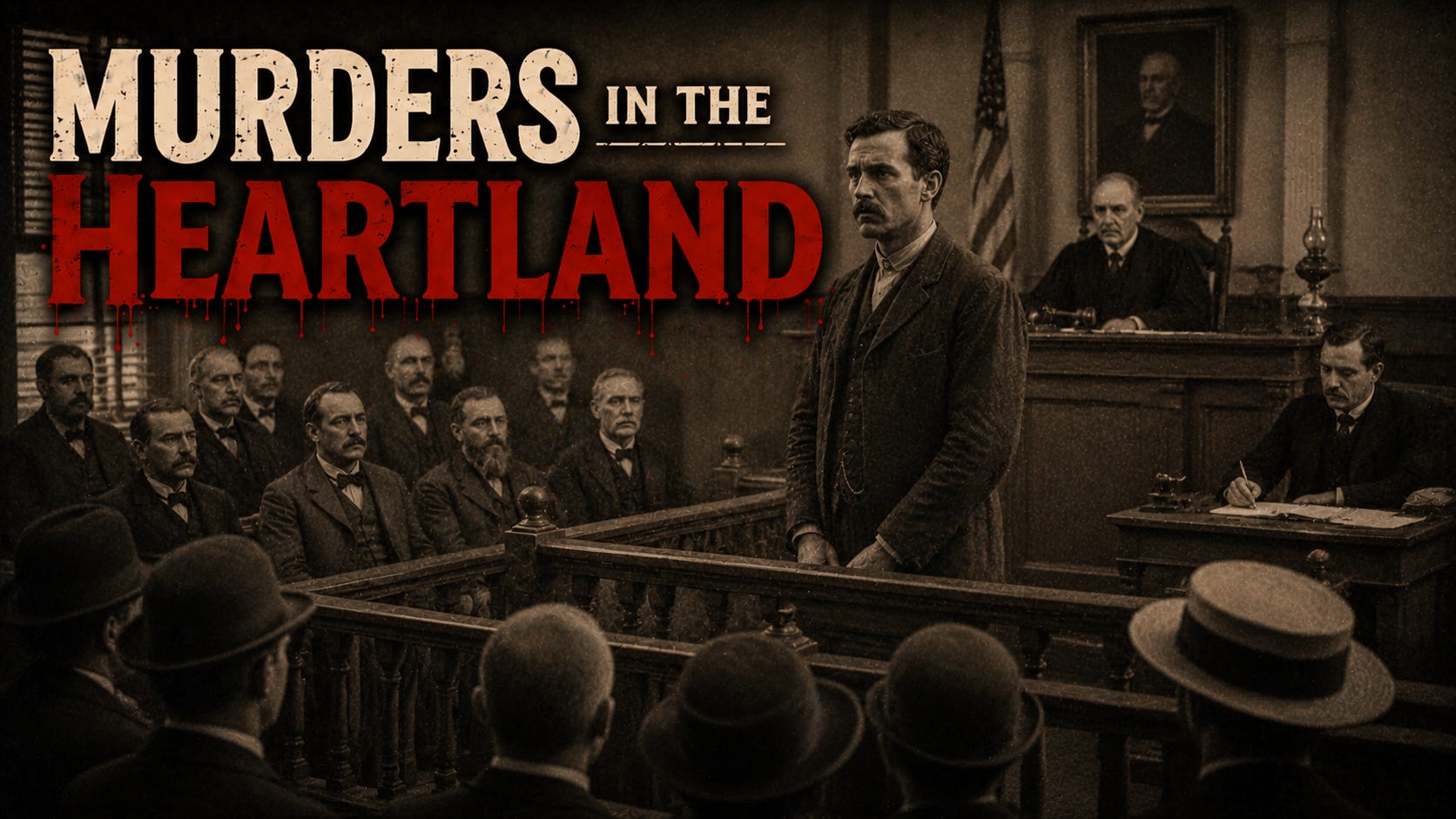
Smokey Creek — September 9, 1900
The boy said his throat was burning.
That is where it begins, or where it ends, depending on which way you are standing when you look at it. A child’s voice, high and frightened, saying “My throat is burning up, he gave me something to kill me,” and then an hour and a half of the particular silence that falls when a small body stops working, and then the long terrible noise of everything that came after.
The child’s name appears in the historical records as Louis, as Oscar, as Lonis, as John — the newspapers of 1900 and 1901 could not agree on what to call him, which is perhaps the saddest fact in a story full of sad facts: that the boy at the center of it could not even keep his name straight across the pages that recorded his death.
He was eight years old. His last name was Mullins. His stepfather was a man named Riley Lowe.
That is what everyone agreed on. After that, agreement became scarce.
***
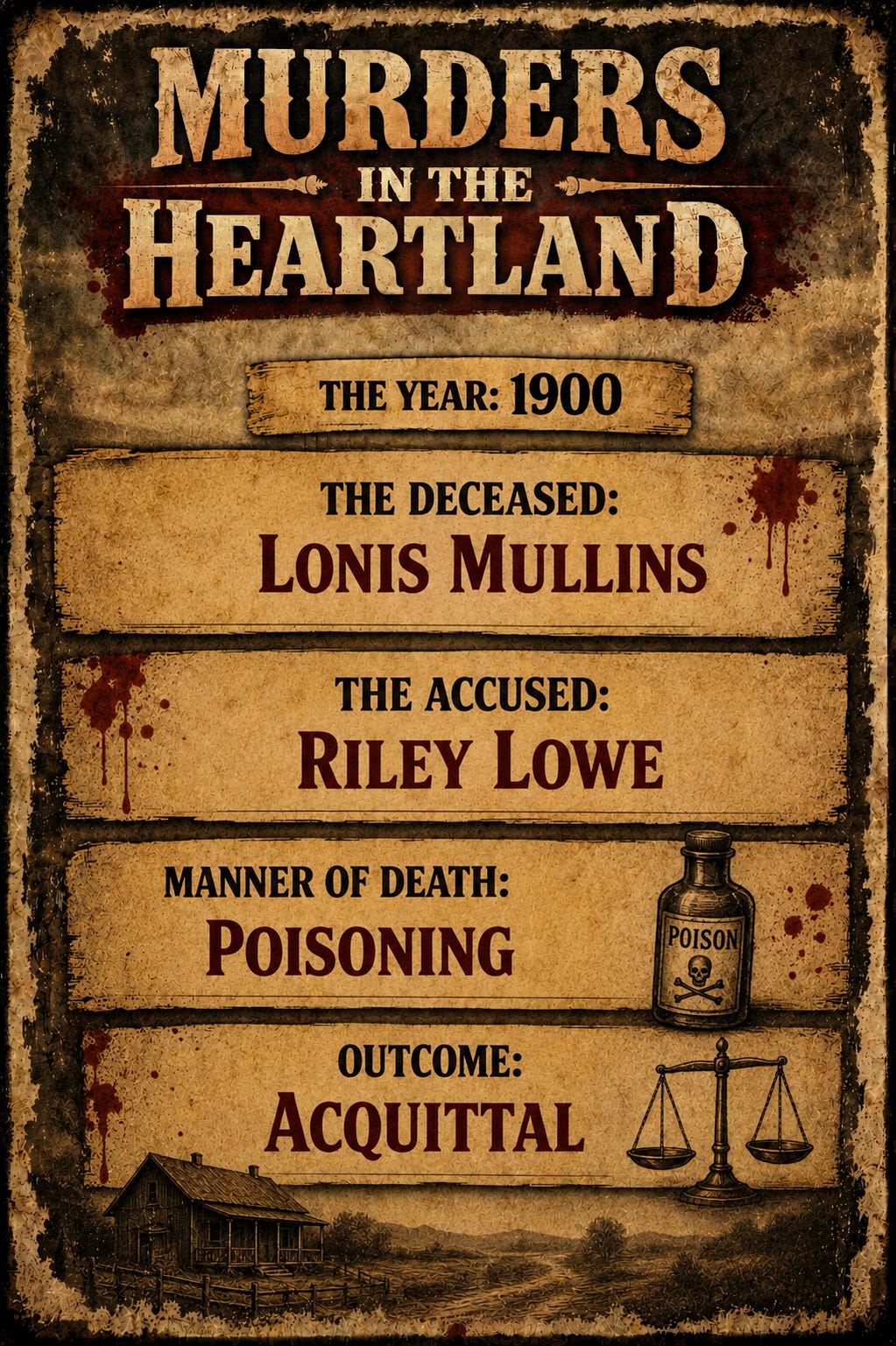
Riley Lowe had come to Tennessee from Kentucky 10 years before any of this happened, but he was from Tennessee in every sense. His great-grandfather was Mikel Low, the first settler of present-day Scott County, and the Lowe family had lived at Smokey Creek ever since. Still do, in fact.
Riley was, by all accounts, presentable. The newspapers – which had a Victorian habit of noting such things, as though a man’s face were evidence – remarked repeatedly on his “good appearance,” on how he was precisely the sort of man you would not expect to feed poison to a child. He had married a woman named Samantha Carroll, a woman who had been married before and had children from that marriage, the children bearing the name Mullins as children do when they belong to a first husband who has died or departed.
By the summer of 1900 they were all living together at Smokey Creek. The census that year recorded the boy’s name as Lonis Low. The other children in Riley and Samantha’s home were also listed with the Low surname.
Also living nearby, or perhaps on the same land — the records press them close together — was Samantha’s mother.
Her name does not appear prominently in the newspapers. She is referred to throughout as “the mother-in-law,” as though her identity has been entirely subsumed by her relationship to the accused, which is the kind of thing that happens to women in court records, then and sometimes now. What we know of her is almost entirely filtered through the testimony she gave and the things that were said about her by people who hated her for giving it.
She hated Riley Lowe. That, at least, no one disputed.
***
He had bought strychnine. This was established early and never seriously contested. He admitted it himself.
Strychnine in 1900 was not difficult to obtain. You went to a store and you asked for it and they gave it to you and wrote it down, because it had legitimate purposes — killing rats, mostly, the eternal rural project of keeping the vermin from the grain stores. Riley Lowe said this was why he bought it. He said it clearly and repeatedly, to anyone who would listen.
The strychnine was in the house.
The boy died on September 9, 1900, with symptoms that the attending physician — who arrived several hours after death and therefore conducted no autopsy, which would matter later — described as consistent with poisoning. The boy had, before he died, told his grandmother that Riley had given him something to kill him. That his throat was burning. That he was burning up.
The grandmother had heard Samantha’s voice, crying out from the house: “Run here, Riley is burning Lonis up.”
That’s what the mother-in-law told authorities. And by the time little Lonis was buried, Riley Lowe was in custody.
***
Here is what Samantha wrote to him, in July of 1900, after his trial:
“Dear husband I write you a few lines to let you know I am well and hope this will find you well.”
She had not been formally educated, in the way that mountain children of that era were educated — enough letters to make words, enough words to make sentences, sentences that tumbled out without much regard for the rules that schoolteachers would later enforce. The letter is phonetic, approximate, and urgent: “I would luft to see you awful well.” The children, she said, wanted him to “hurry and come back home.”
And then, the heart of it:
“You know my mother caused all this trouble and that I would never have been against you if it had not been for mother persuading me to mistreat you.
“She sed that I could live without you and she sed I mite live on the place and that some one would help me along.
“She has done sed that if I didn’t hold my tongue she would put me off the place.
“Don’t let mother know I wrote you any letter.”
She signed it “from your wife until death” and asked him to tear it up, and he did not tear it up, and it survived, which is the way of letters that are meant to be destroyed — they persist, they surface, they become the thing that everyone reads.
What to make of it depends, again, on where you are standing.
A wife who believed in her husband’s innocence, writing in secret, at risk of being turned out of her home, to tell him that her mother had manufactured the case against him — this is one version.
A wife who had seen what her husband had done and was now, in the aftermath, caught between her mother and her marriage, trying to thread a needle that had no thread — this is another.
The letter does not resolve this. Letters rarely do. They tell you what people wanted to say in the particular moment of saying it, and they tell you nothing reliable about what those people actually knew.
***
The trial began on Monday, May 13, 1901, in Huntsville, in the circuit court of Scott County.
The prosecution was handled by W.H. Potter, H. Clay James, and Assistant Attorney General Holloway. The defense was handled by Daniel Jeffers & Son. Judge Hicks presided.
The mother-in-law took the stand and told what she had seen and heard: the cry from the house, the burning child, the dying declaration of an eight-year-old boy who said Riley had given him something to kill him. She told it, the defense later argued, with malice. With a manner toward the defendant that no neutral witness would have shown. She had said, before the boy died, before Riley was ever arrested, that she would one day cause him serious trouble. This was established. This was, in fact, central to what came next.
But the jury did not know what came next. The jury knew only what it heard in the courtroom in Huntsville, and on Wednesday, May 15, 1901 — two days after it started — they returned a verdict.
Guilty of murder.
Riley Lowe looked, a reporter noted, “very much worn and haggard.” He had been confident of acquittal. He did not expect to be found guilty. He was stunned.
He appealed immediately, and lost immediately. The sentence was handed down two days later: death. Judge Hicks set the hanging for July 12. He would become the second man in Scott County’s history to be legally hanged.
***
Riley Lowe was taken to Knox County Jail in Knoxville to await execution. There, on July 2, 1901 — 10 days before he was scheduled to die — a German Lutheran minister named Rev. J.A. Lauritzen baptized him. Lauritzen had been coming to the jail every Sunday for six weeks. Riley Lowe went into whatever water a jail can provide and came out the other side with his death sentence intact and his soul squared.
He had filed an appeal.
He was 35 years old. He had that “good appearance” the newspapers kept referring to. He insisted, to anyone who would listen, that he had not killed the boy.
***
The Tennessee Supreme Court had five judges. They listened to E.E. Houk and Sam Epps Young argue for Riley Lowe’s life, and they listened to General Pickle argue for the state, and then they went away and thought about what they had heard.
They reversed the conviction in November 1901.
The grounds were the mother-in-law: her prior statements of malice toward the defendant, her manner on the stand, the Supreme Court’s conclusion that a witness who had announced her intention to cause a man serious trouble before a crime had ever been charged against him was a witness whose testimony required harder scrutiny than the circuit court had applied. The case was remanded. A new trial was ordered.
Riley Lowe, in the Knox County Jail, was reported to be “one of the happiest men” the facility had seen in a long time. He told the Knoxville Sentinel that his mother-in-law had always hated him, that he had seen her opportunity and taken it, that his wife had been kept from writing to him — that Samantha had to “steal out” to communicate with him at all.
He was returned to Scott County. He insisted he would be acquitted when he got his new trial.
***
The second trial came in May 1902. The jury assembled and heard the evidence and could not agree. They reported several times that they were deadlocked. Then they came back with a verdict.
Not guilty.
Riley Lowe had been in jail continuously since September of 1900 — a year and eight months — and now he walked out of the Scott County Courthouse into whatever light was falling on Huntsville on that May day a free man by the accounting of 12 people who had heard everything and decided it was not enough.
The Chattanooga News called it “one of the most celebrated and hotly contested cases ever tried at this bar.”
The boy in the ground had no comment.
***
Now comes the part that history renders in the flat, affectless language of census records and cemetery headstones, which is sometimes the most haunting language of all.
Riley Lowe — “Rollie,” his family called him — was later killed by former Sheriff Frank Hughett and was buried at the Phillip Lowe Farm Cemetery at Smokey Junction.
Samantha outlived him considerably. She died on Oct. 6, 1943, which means she lived through two world wars and the Depression and the whole grinding transformation of the twentieth century, a woman who had written a secret letter in 1900 and asked her husband to tear it up and he hadn’t and the letter had become evidence and none of it had mattered in the end — or mattered in ways that don’t appear in official documents.
Her headstone says “Carroll.” Now Lowe. Carroll, her maiden name, the name she had been born with, and the name she apparently returned to. The 1910 census lists her as divorced. The 1920 census and every one after lists her as widowed. Her children continued going by Carroll, too.
Her mother — the mother-in-law who was at the center of it all — was Angeline Mason Carroll, married to a man named Huston “Huse” Carroll. She died in 1915.
What she said on that stand in Huntsville in May 1901 — “I heard my daughter cry out, I went to the house, the child told me he had given something to kill him, the child died” — those words are in the record. Whether they were true, whether they were the truth as she understood it, whether they were something else — the record has no opinion.
The Supreme Court of Tennessee had an opinion. Two juries had opinions. The first jury decided one thing and the second decided another, and in the gap between those two decisions, a man spent a year and eight months in jail and was baptized by a German Lutheran minister and wrote letters and waited and got out and lived the rest of his life in Scott County.
The boy — Louis, Oscar, Lonis, John, all the names the newspapers gave him and took back — was eight years old. He was buried somewhere in that mountain country but no one knows where. He doesn’t have a headstone to identify his grave. He never got justice, which makes this one of the saddest murder mysteries in Scott County’s history. Most mysteries don’t end in mystery. This one does.
***
There is a letter. It survived because it was not torn up.
“I would not have mother know I wrote you for nothing … From your wife until death.”
***
The valley at Smokey Creek still exists. The creek still runs. The cemeteries still hold their dead without commentary, the way cemeteries do, the headstones tilted slightly with age and frost, the names sometimes worn to suggestions.
Somewhere in that ground is Riley Lowe.
Somewhere else, nobody knows, is the boy.
The mother-in-law in another place, and Samantha in another.
What happened in that house on September 9, 1900, when a child’s throat began to burn — who stood over him, who fed him what, who knew and who didn’t, who lied and who told the truth —
That is a room the record does not enter.
It never did.
Editor’s Note: This is the latest installment of Murders in the Heartland, the IH’s reimagined series covering particularly noteworthy murders that have been committed in Scott County through the years. In many instances, descendants of both the victims and the perpetrators still live in our community. The intent is not to reopen old wounds or to cast judgment, but to document past events that have an indelible impact on our community’s history. At the conclusion of the series, our book by the same name will be republished in a second, revised edition.
Thank you for reading. Our next newsletter will be The Daybreaker bright and early Monday morning. If you’d like to update your subscription to add or subtract any of our newsletters, do so here. If you haven’t yet subscribed, it’s as simple as adding your email address!
◼️ About the IH • IH Sports Network • The Encyclopedia of Scott County
◼️ Subscribe • Sponsor • Manage Your Account
◼️ Follow us on Facebook, Instagram, X/Twitter, YouTube
Our Newsletters:
• Monday morning: The Daybreaker (news & the week ahead)
• Tuesday: Echoes from the Past (stories of our history)
• Wednesday: Threads of Life (obituaries)
• Thursday evening: The Weekender (news & the weekend)
• Friday: Friday Features (beyond the news)
• Sunday: Varsity (a weekly sports recap)