

Friday Features: Vengeance against the sheriff
Plus: The Spring Hiking Challenge begins


You’re reading Friday Features, a weekly newsletter containing the Independent Herald’s feature stories — that is, stories that aren’t necessarily straight news but that provide an insightful look at our community and its people. If you’d like to adjust your subscription to include (or exclude) any of our newsletters, do so here. If you haven’t subscribed, please consider doing so!
Today’s newsletter is sponsored by First National Bank. Since 1904, First National Bank has been a part of Scott County. First National is local people — just like you. Visit fnboneida.com or call (423) 569-8586.

Murders in the Heartland: Vengeance against the sheriff
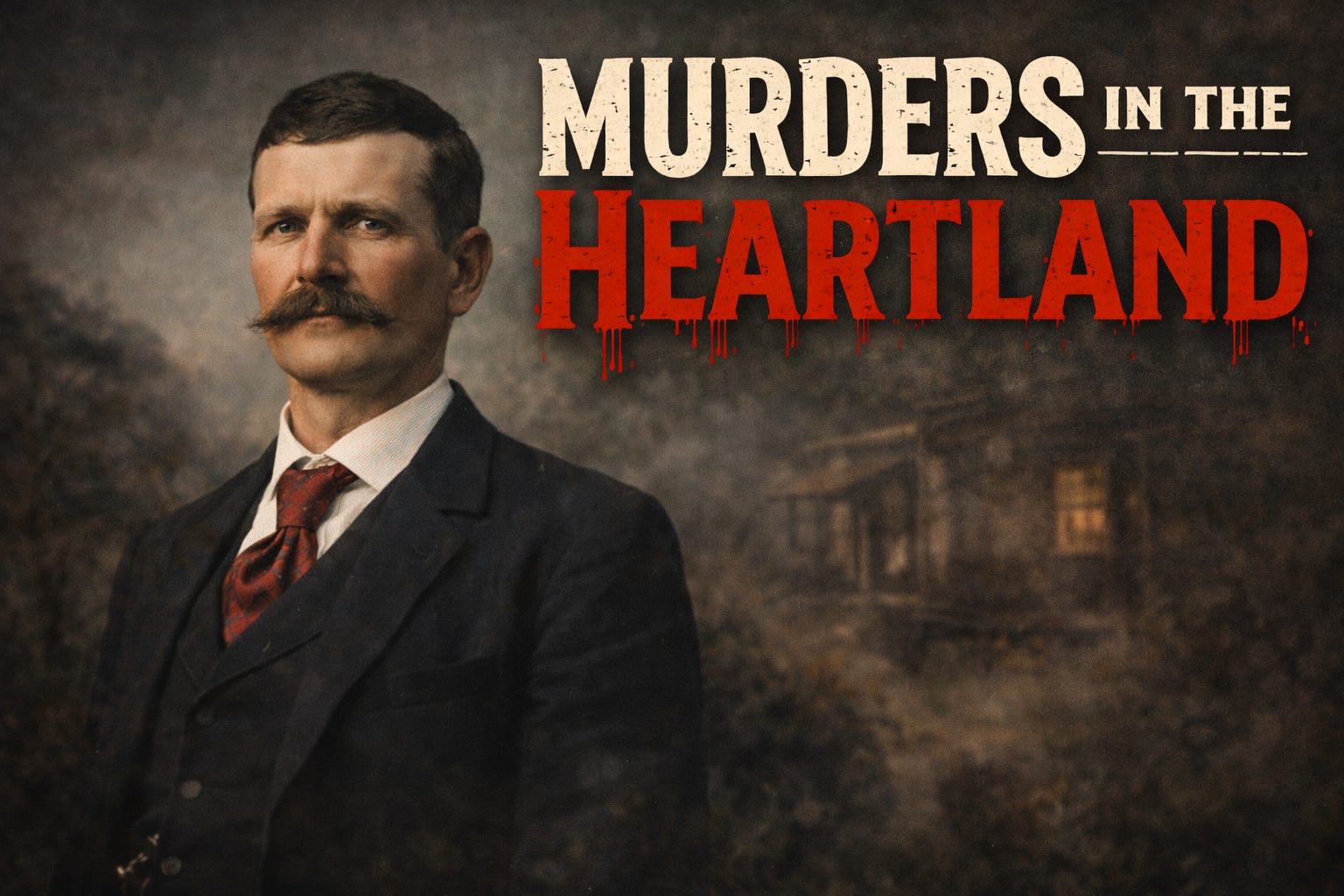
There is a particular kind of man the mountains make – not invincible, exactly, but durable in a way that baffles the men who keep trying to break him. Frank Hughett was that kind of man. He was shot. Poisoned. Shot again. Men from the hills of Scott County spent the better part of a year trying to kill him before they finally got it right, and even then, it took an ambush on a Sunday morning, with his wife and two-year-old baby nearby, to bring him down.
He was fifty-nine years old, sweeping the front steps of a railroad commissary, when the bullet found him.
He was dead in ten minutes.
But the story was hardly that simple.
***
To understand Frank Hughett, you have to understand the country that made him. Scott County in the late nineteenth century was a place where the law wore a face and rode a horse and could be found at specific addresses – which meant it could also be targeted, ambushed, and settled with. The office of high sheriff wasn’t an abstraction. It was a man. And if you had business with the law, you had business with the man specifically.
And folks in the mountains had ways of settling accounts that were not always through the courts.
Frank Hughett was born in March 1851, the son of John Hughett and Christena Lewallen, out of Robbins and the Brimstone Creek country. His father was a justice of the peace – Squire Hughett, folks called him – and the Hughett name was embedded in the landscape the way old names get embedded out there, in the creek hollows and ridge lines and the small places on maps that only locals can find. There was a Hughett post office, near where Huntsville Branch empties into Brimstone Creek, run by his brother, Jasper, who would later help build the bank and the high school down in Robbins.
There were a total of ten children in the Hughett family. Christena died in her forties and was buried at the family cemetery on Brimstone. Squire Hughett lived out his years with Christena’s sister, Lucinda – a woman who could not marry again without forfeiting the monthly pension from her first husband, Capt. William Robbins, who had helped raise the Scott County Home Guard during the Civil War, had his home attacked in what became known as the Battle of Brimstone, and died of typhoid fever in Lexington, Kentucky, far from the mountains he’d set out to defend.
Frank married Amanda – one of William and Lucinda’s daughters – and they had six children together. When Amanda died around 1891, Frank remarried to Abigail Cecil. Then he married a third time, to Rhoda Shoopman, and they had a child together in 1908, when Frank was in his late fifties. There is something quietly remarkable about that detail – a man pushing sixty, starting again, a new baby in the house – and it makes what happened two years later land with even heavier weight.
***
He was first elected Scott County’s ninth sheriff in 1888, succeeding Beaty Cecil of New River. He was reelected in 1890 and 1892, served out his three terms, and stepped aside as the law required. He left the job to John Goad, who had his own difficult tenure – tasked eventually with hanging a convicted murderer named Mike King, a duty that bothered Goad so profoundly that he refused to run for sheriff again. He ran for county trustee instead. Some burdens you carry out of office and try not to look at directly.
Hughett came back in 1896. He ran again and won again, becoming the first man in Scott County history to serve the office on two separate occasions. Whatever it was the work did to him, whatever weight it added to those years of riding out to hard places and standing between the law and people who didn’t want the law standing anywhere near them – it didn’t appear to drive him out. He served until 1900, and then went on living in the county he’d spent years policing.
Then, in the winter of 1910, Frank Hughett was part of a posse.
The man they were after was Riley Lowe, wanted on a larceny charge. He was accused of stealing a moonshine still, which sounds almost quaint until you understand that in Scott County in 1910, a man’s still was his livelihood, and stealing one was serious business, and the men who ran them were not the kind to accept the loss quietly. The posse found Riley Lowe. Frank Hughett killed him.
From that moment on, Hughett was a marked man. Riley’s family had their own accounting to do.
***
June 1910. Oneida. Someone shot Frank Hughett in the street.
The shooter apparently believed he’d finished the job, because when Hughett fell, the man turned and fled. This was his mistake. Hughett regained consciousness – came back up out of whatever dark place the bullet had sent him toward – and gave chase. Wounded, bleeding, fifty-nine years old, he went after the man who had just shot him.
No one was ever apprehended.
Days later, someone poisoned his whiskey.
The Knoxville Sentinel reported that Hughett “suffered much” from the poisoning, which is the newspaper’s restrained way of saying that a man survived being shot and then survived being poisoned in the same month, which should perhaps be classified as something beyond ordinary human endurance. The paper also noted that Hughett “is a man of great bravery and refuses to move away.”
Refused to move away.
That was the essential thing about Frank Hughett. The mountains were trying to kill him – methodically, patiently, working through the available methods – and he would not leave. Whether that was courage or stubbornness or some combination of the two that becomes indistinguishable after enough years in hard country, he stayed. He took a job as a foreman on the railroad at Cook’s Camp on Smokey Creek. He brought his wife and two-year-old child and went to work.
And on Sunday morning, September 19, 1910, at around eight o’clock, he was sweeping the steps in front of the commissary when someone fired from a cluster of bushes on the mountainside above the camp.
Two shots. Under his right arm.
He was dead in ten minutes.
***
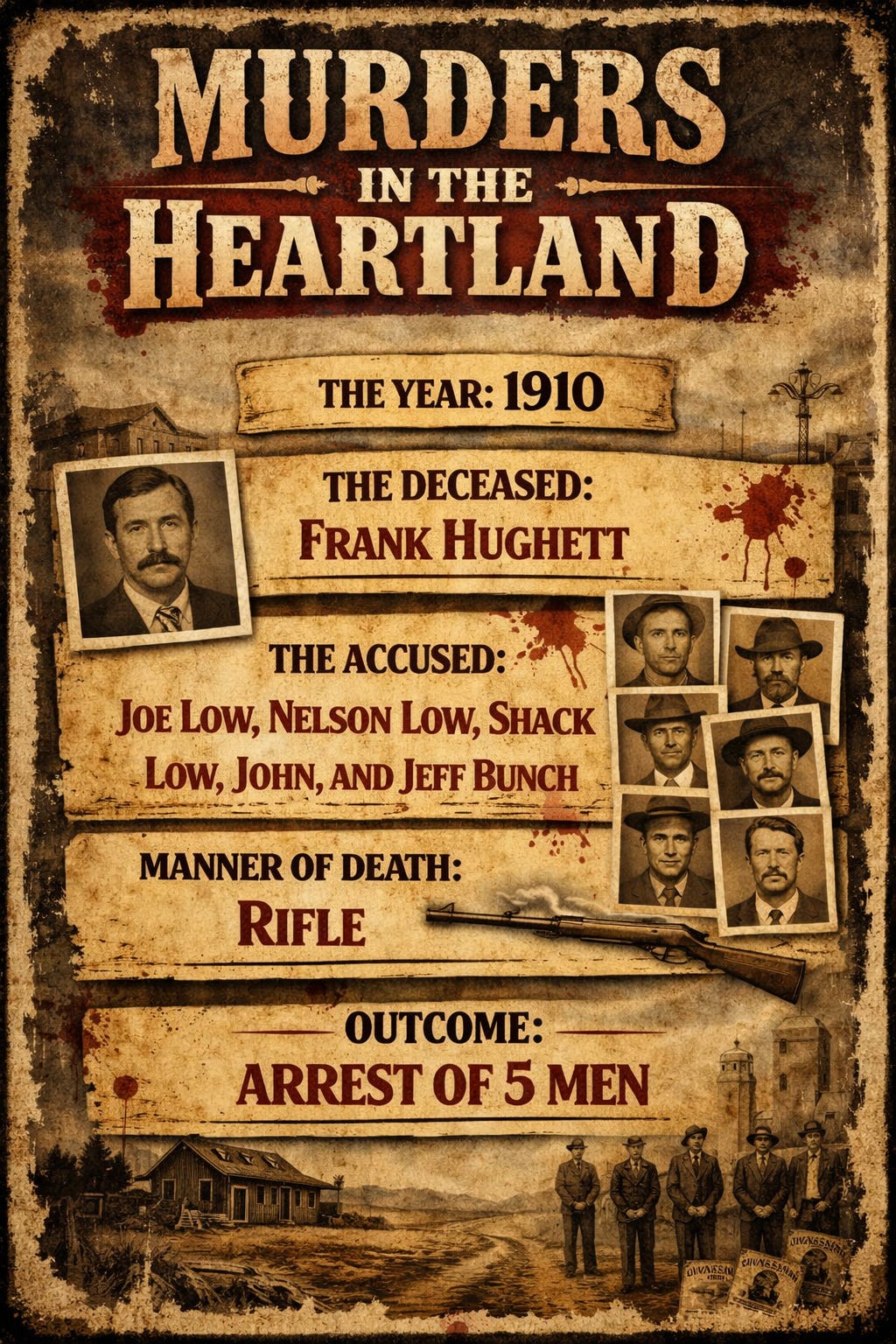
Another person in the camp saw a man run from the bushes after the shots. Bloodhounds were brought in from Somerset, Kentucky, and they followed the track with the patient, unhurried certainty that bloodhounds have – noses to the earth, reading the story the ground was telling – until the trail led to arrests. Five men: Joe Lowe, Nelson Lowe, Shack Lowe, John Bunch, and Jeff Bunch. The Lowe name was right there in the middle of it, as Hughett might have known it would be. Riley Lowe’s brother and kin, settling the account that had been opened in the winter.
A newspaper called it “cold-blooded murder in a railroad camp.” That phrasing has the flat declarative quality of a verdict – not quite outrage, not quite grief, just the mountain chronicle doing what it does, setting the facts down in ink so it doesn’t get lost in the hills.
Frank Hughett was buried at Robbins Cemetery back in the community where he was born.
***
Twenty years later, in June 1930, his son Reuben went the same way.
Reuben Lafayette Hughett was forty-three years old, a deputy U.S. Marshal, working a warrant down in Knoxville at Copper Ridge. The suspect was Harrison Welch, charged with selling liquor. When Welch was arrested, he asked for a moment to tell his wife. Reuben Hughett, his father’s son in the way that runs bone-deep in some families, agreed. He followed Welch into the house.
The two men tussled, and Reuben was shot.
They buried Reuben Hughett at Robbins Cemetery, too, beside his father. Two men. Two badges. Two ambushes. Both over whiskey. Twenty years of the same mountain arithmetic, patient and unresolved, the same lesson learned by the same family twice in the same generation, which is not a lesson at all but a weight – the kind that accumulates in county records and grave markers and the long silence of a place that has seen more than it can say.
***
There is an old story in Scott County about the men who went after Frank Hughett’s job. One of his predecessors, John Goad, hanged a convicted murderer and found he couldn’t put it down afterward, couldn’t stop seeing it, couldn’t keep carrying the thing the office required him to carry. So he found a different job.
Frank Hughett did not find a different job. He stayed. He came back. He was shot and he gave chase. He was poisoned and he refused to leave. He brought his family to a railroad camp and swept the front steps on Sunday mornings and went on being exactly what he had always been – a man the mountains had made and could not seem to unmake.
Until they did.
It took an ambush. It took a cluster of bushes on a hillside and a Sunday morning and a man with a rifle who waited until Hughett wasn’t looking. It took every advantage the other side could arrange, and even then it was over in ten minutes, which feels like the last thing a man like that owed the mountains that raised him.
Ten minutes.
The bloodhounds followed the track. The arrests were made. And the Robbins Cemetery received another Hughett, and the hills went on keeping their counsel, and the creek moved through the hollow where the old post office used to be, and the November light came down thin and cold, and the county went on writing itself, one violent chapter at a time, in the only language it had ever really known.
Editor’s Note: This is the seventh installment of Murders in the Heartland, the IH’s reimagined series covering particularly noteworthy murders that have been committed in Scott County through the years. In many instances, descendants of both the victims and the perpetrators still live in our community. The intent is not to reopen old wounds or to cast judgment, but to document past events that have an indelible impact on our community’s history. At the conclusion of the series, our book by the same name will be republished in a second, revised edition.
The Spring Hiking Challenge begins!
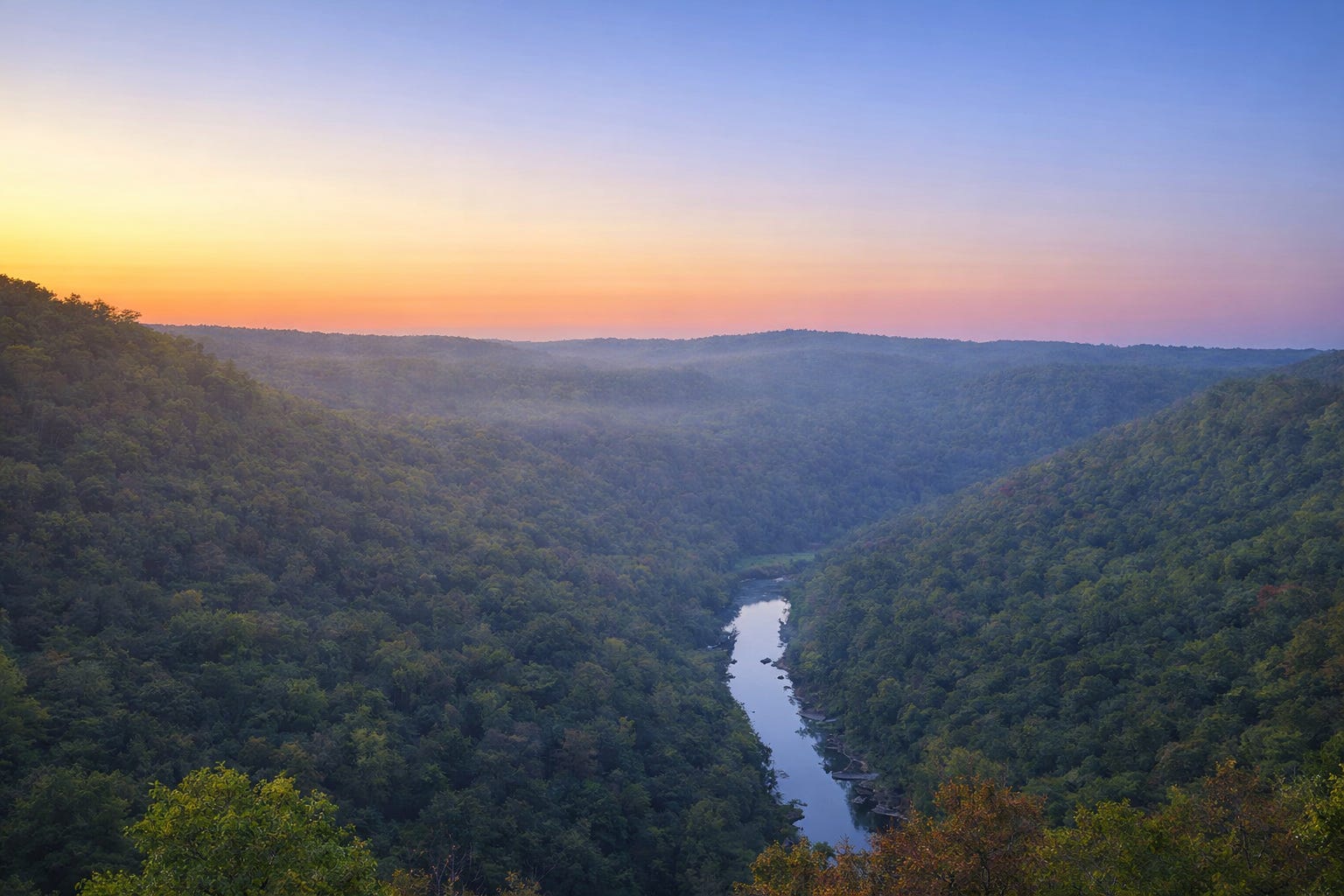
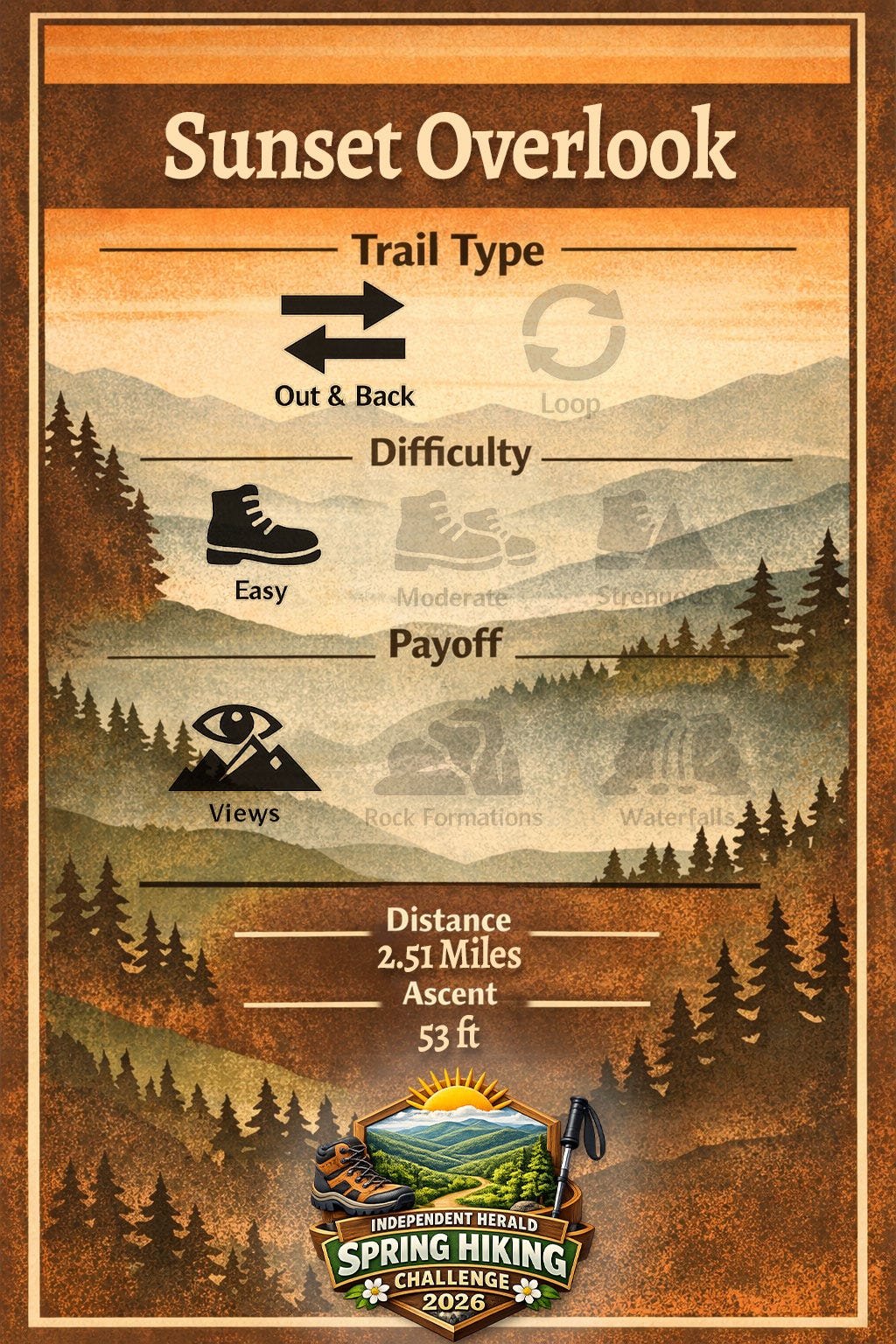
The 2026 Spring Hiking Challenge begins this week — the first official week of spring — with a short, easy stroll to Sunset Overlook.
In making this hike, we’re returning to the site of the inaugural Twenty Week Hiking Challenge back in March 2015, when more than 700 hikers joined us on Week 1 for the hike to Sunset.
We chose the hike to Sunset Overlook because we want to start slow and easy for novice hikers who aren’t experienced in the woods. Sunset Overlook is one of the easiest trails the Big South Fork has to offer — subjectively, it’s second only to the Bandy Creek Loop. Angel Falls Trail is an easier walk, but further distance (about four miles).
The purpose of the Spring Hiking Challenge is to encourage local residents to explore the Big South Fork and discover the beautiful places that exist in our back yard — places that some people who have lived in this area their entire lives have never seen before. In the process, we hope participants will discover that hiking is an excellent health tool, not just for physical fitness but maybe even more so for mental fitness.
Over the next 14 weeks (ending the final week before summer officially begins in June), we’ll hike 14 trails throughout the Big South Fork. We’ll avoid horse trails, which are generally more difficult to walk, and stick solely to hiking trails. Each trail will feature at least one of overlooks, rock formations, or waterfalls, along with other points of interest. Each trail will include a “Make It Better” option for hikers that want to add some mileage to their effort. Each will also include a virtual scavenger hunt — requiring hikers to pay close attention to their surroundings to find a point of interest along the trail — with a prize randomly awarded to someone who finds and documents the site we’re looking for.
Hikers will document their participation by sharing photos of their hike on social media with the hashtag #SpringHikingChallenge — or, if they do not have social media, photos can be emailed to newsroom@ihoneida.com. At the end of the challenge, we’ll award a grand prize to two people — one adult, one youth, randomly chosen — who complete all 14 hikes. We’ll also award a prize for the best photograph that’s taken throughout the challenge. Those prizes, as well as the weekly prizes, will be announced in our hike stories and on our Facebook page.
Each week, the hike will be announced, along with full details about it, on our website — www.indherald.com— by Thursday.
So, with all that said, let’s get started!
Click here to continue reading this week’s full trail description!
Thank you for reading. Our next newsletter will be The Daybreaker bright and early Monday morning. If you’d like to update your subscription to add or subtract any of our newsletters, do so here. If you haven’t yet subscribed, it’s as simple as adding your email address!
◼️ About the IH • IH Sports Network • The Encyclopedia of Scott County
◼️ Subscribe • Sponsor • Manage Your Account
◼️ Follow us on Facebook, Instagram, X/Twitter, YouTube
Our Newsletters:
• Monday morning: The Daybreaker (news & the week ahead)
• Tuesday: Echoes from the Past (stories of our history)
• Wednesday: Threads of Life (obituaries)
• Thursday evening: The Weekender (news & the weekend)
• Friday: Friday Features (beyond the news)
• Sunday: Varsity (a weekly sports recap)